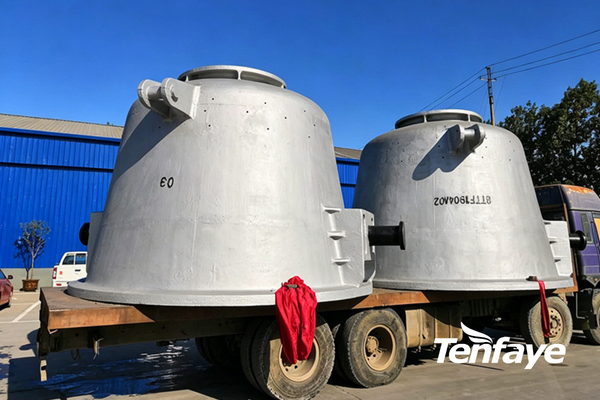
In the steel metallurgical industry, the
slag pot is a critical heavy-duty component for holding and transporting molten slag. The material chosen for these slag steel ladles directly impacts plant safety, maintenance costs, and operational efficiency.
While cast iron was historically preferred due to its lower initial procurement costs, cast steel (such as GS-16Mn5, G20Mn5, or ASTM standard grades) has become the definitive industry standard for modern steel mills and smelting plants.
So, when evaluating metallurgical equipment longevity, why do cast steel slag basins consistently outperform cast iron options?
1. High-Efficiency Thermal Fatigue Resistance (High-Temperature Shock Protection)
During steelmaking and slag tapping, molten slag is poured into the slag hauling vessel at extreme temperatures ranging from 1500°C to 1700°C. The vessel walls undergo sudden, severe heating, followed by rapid cooling during transportation or air cooling. This dramatic temperature swing creates massive internal thermal stress.
● Cast Steel: Outstanding Ductility and Mechanical Stability
Cast steel possesses exceptional plasticity and elongation properties. Under extreme heating and cooling cycles, it absorbs and releases internal thermal stress through micro-deformation. This eliminates structural damage and ensures the
molten slag vessel achieves a significantly longer service life.
● Cast Iron: High Risk of High-Temperature Cracking
Cast iron has poor plasticity and is virtually unable to relieve internal stress through deformation. Under continuous thermal shock, network micro-cracks (thermal fatigue cracks) quickly develop on the surface. Over time, these cracks penetrate the container walls, leading to catastrophic slag leakage and severe safety hazards.
2. Excellent Low-Temperature Impact Toughness (Extreme Cold Conditions)
For steel mills located in high-latitude regions (such as Canada, Russia, Kazakhstan, or Nordic countries), winter ambient temperatures frequently drop to -40°C or lower. In these environments, a material's impact toughness becomes the ultimate baseline for safe production.
● The Resilience of Cast Steel at Sub-Zero Temperatures
Through precise chemical composition design of low-alloy cast steel (such as G20Mn5 or GS-16Mn5), the material maintains excellent impact toughness even under extreme conditions from -20°C to -40°C. It reliably absorbs heavy external impacts without fracturing, ensuring uninterrupted production in harsh winter climates.
● The Fragility of Cast Iron in Freezing Conditions
Cast iron is inherently a brittle material. In low-temperature environments, its internal graphite structure further intensifies this brittleness, raising its ductile-to-brittle transition temperature. Consequently, even a minor collision or vibration can cause a cast iron slag container to suffer sudden, catastrophic shattering without warning.
3. Superior Weldability and Repairability (Lowering Total Lifecycle Costs)
Over years of heavy-duty operations, a
smelting slag pot will inevitably experience localized damage, wear, or minor cracking. At this stage, whether the material is easily repairable dictates its true economic value.
● Cast Steel Features High Repairability
Due to its lower carbon content and precisely balanced alloy elements, cast steel exhibits excellent weldability. When surface wear or cracks occur, maintenance teams can easily perform gouging, welding, and post-weld heat treatment. This completely restores the structural integrity of the
industrial slag bucket and multiplies its service life.
● Cast Iron Is Extremely Difficult to Weld
Because cast iron contains a high carbon content of 2.5%–4.0%, welding easily generates a brittle martensite micro-structure and high residual stress near the weld seam. This causes immediate new cracks to propagate during subsequent thermal cycles. Damaged cast iron units usually must be scrapped entirely, heavily inflating equipment replacement costs.
4. Higher Tensile Strength to Handle Massive Heavy Loads
Modern metallurgical plants manage immense single-batch volumes, requiring
slag residue pots to safely carry dozens or even hundreds of tons of liquid or solidified steel slag. This demands absolute structural integrity from the vessel.
● Higher Yield Strength Prevents Heavy Deformation
The tensile and yield strength of cast steel far exceeds that of standard cast iron. It effortlessly withstands the massive static loads of heavy slag, dynamic loads during overhead crane transport, and high torsional stress during tilting and dumping operations.
● Thinner, Lighter Designs Optimize Heat Dissipation
To achieve the same structural strength, a cast iron vessel requires extremely thick walls due to its low tensile properties. This adds unnecessary dead weight to the equipment and impairs heat dissipation, which conversely accelerates thermal stress damage.
Conclusion: The Smarter B2B Procurement Strategy
While the initial purchase cost of a cast steel slag disposal pot may be slightly higher than cast iron, it delivers a much lower Total Cost of Ownership (TCO) in the long run thanks to its extended service life, minimized maintenance downtime, lower failure rates, and reliable repairability. This is why leading global metallurgical enterprises explicitly mandate high-grade cast steel for their central slag handling systems.
Custom Slag Pot Manufacturing Services by Tenfaye Tenfaye brings 20 years of expertise in heavy steel casting production, specializing in large-scale, custom 1-150 ton premium steel castings for the mining, cement, and metallurgical industries. Our manufactured slag pots, rotary kiln girth gears, and riding rings fully comply with rigorous international quality benchmarks. Every critical component undergoes 100% Non-Destructive Testing (UT & MT) to guarantee zero internal casting defects.
Contact our engineering team today with your drawings for a fast, technical quotation!