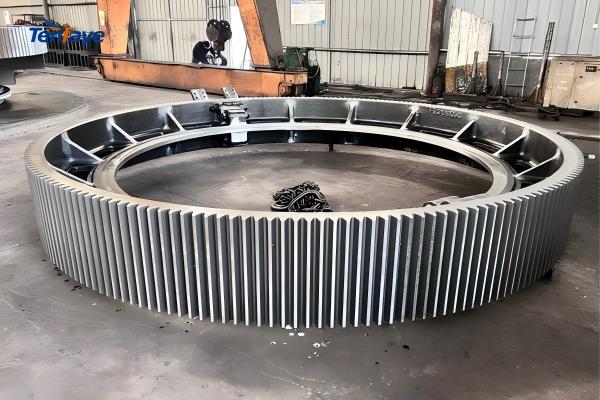
A rotary kiln is a massive, inclined cylindrical vessel that must rotate continuously, slowly, and smoothly while overcoming huge friction and the gravity of internal materials.
The rotary kiln gear ring fulfills two critical roles within the rotary kiln system:
- Core Power and Torque Transmission: The driving system of a rotary kiln typically involves a main motor powering a pinion gear, which meshes openly with the large girth gear mounted around the kiln shell. The girth gear distributes this massive torque evenly across the giant kiln body, serving as the ultimate power hub to realize the kiln's rotation.
- Accommodating Thermal Expansion Displacement: Because the interior of a rotary kiln operates long-term in high-temperature environments exceeding 1000°C, the kiln shell undergoes drastic thermal expansion. Therefore, high-quality rotary kiln girth gears usually feature a split structure (two-piece design) and are secured to the kiln body via professional tangential spring plates. This design allows the gear to maintain excellent deformation cushioning when the kiln shell thermally expands, ensuring transmission precision.
2. Operational Impacts: How Girth Gear Quality Affects Production
In heavy industrial B2B sectors, the girth gear is classified as a critical maintenance and repair component. If a girth gear fails, it leads to the following consequences:
1. Costly Downtime and Massive Financial Losses
Rotary kilns generally operate continuously 24 hours a day. If a girth gear suffers from sub-standard casting quality—such as internal shrinkage, sand holes, or residual stress cracks—it will eventually lead to tooth breakage or fatigue spalling under relentless, heavy-load torque. Once the girth gear is damaged, the entire concentrator plant or cement production line must shut down immediately for major overhauls. The hoisting, alignment, and replacement of such heavy, large-scale components can easily take days or even weeks, resulting in production losses that can soar up to hundreds of thousands of dollars per day for the enterprise.
2. Transmission Efficiency and Operational Lifespan
If the machining tolerances of the girth gear's tooth surface do not meet technical standards, or if axial runout occurs during operation, it will cause abnormal backlash between the girth gear and the pinion. This not only generates violent vibrations and severe noise but also accelerates the wear and tear on the pinion and the reducer, drastically shortening the service life of the entire drivetrain system.
3. What Standards Must a High-Quality Rotary Kiln Girth Gear Meet?
Given the harsh working environments of rotary kilns, major industrial buyers typically prioritize the following three aspects when customizing girth gears:
- Premium Materials & Advanced Heat Treatment: Standard carbon steel cannot endure this level of heavy-duty transmission. High-strength alloy steels, most notably ZG42CrMo or ZG35CrMo, are preferred. These materials must undergo rigorous quenching and tempering (Q&T) to achieve an optimal tooth surface hardness (typically HB 210-250), ensuring a structure that is hard on the outside yet tough on the inside.
- 100% Non-Destructive Testing (UT & MT Inspection): Before leaving the factory, castings must pass 100% Ultrasonic Testing (UT) and Magnetic Particle Testing (MT). This ensures that the girth gear is completely free of internal invisible blowholes, cracks, and slag inclusions, eliminating the risk of on-site fractures right from the source.
- Precision Non-Standard Surveying & Customization (Customization to Drawings): No two rotary kilns are identical anywhere in the world. Whether it requires a straight spur gear or a helical gear, the foundry must possess exceptional capabilities in non-standard drawing restoration and heavy-duty gear hobbing processing.
The rotary kiln girth gear is far more than a simple transmission part; it is the vital lifeline for the operation of the entire industrial furnace system.
Tenfaye possesses 20 years of experience in heavy steel casting production, specializing in the customization and precision machining of 1-150 ton large-scale non-standard steel castings. We supply high-performance rotary kiln girth gears, riding rings (tyres), and ball mill spare parts to global mining and cement giants. All major transmission components strictly support 100% UT/MT rigorous quality inspection standards.
Welcome to provide your drawings or contact our technical experts to get a professional quote!