The
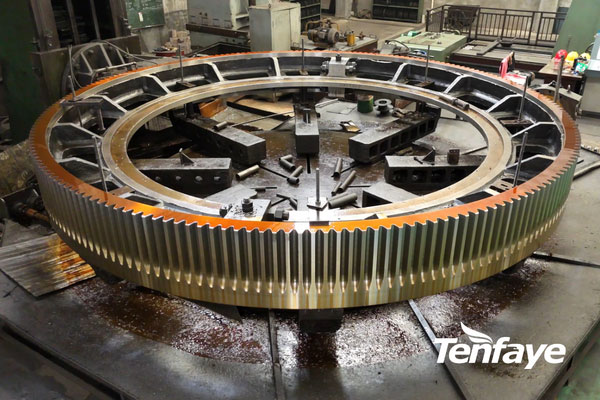
Girth Gear, as the core component of the drive systems for large ball mills, autogenous mills, and cement rotary kilns, plays a critical role in the operation of the entire heavy-duty production line.With global mining and cement industries raising their standards for reducing unscheduled downtime, improper selection of the drive girth gear can easily trigger catastrophic tooth breakage, leading to severe production stop losses for enterprises. Therefore, how should plant managers, maintenance procurement specialists, and global MRO engineering contractors make the ultimate choice between large cast steel girth gears and forged/welded options?
I. Why Extra-Large Scale Equipment Prefers the Casting Process
In recent years, a common misconception has persisted within the industrial procurement field—that forged metal inherently outperforms cast alternatives in every single scenario. However, engineering experts point out that when the gear diameter breaches the critical threshold of 4 to 8 meters, the balance point for both mechanical performance and economic ROI shifts dramatically. For extra-large specifications of Rotary Kiln Drive Gears and
Ball Mill Girth Gears, the casting process delivers three irreplaceable advantages in heavy industrial applications:
1.Forging Technology Reaches Equipment Bottlenecks: Since forging heavy steel components requires massive ring-rolling mills, once a girth gear's diameter exceeds 4 meters, single-piece monolithic forging faces extreme equipment constraints and manufacturing bottlenecks, making it nearly impossible to shape as a single integrated piece.
2.Casting Offers Higher Cost-Efficiency: Forging an extra-large diameter gear ring as a single piece is highly impractical and prohibitively expensive. In contrast, heavy Steel Castings technology demonstrates a massive cost advantage for heavy-tonnage, non-standard components, making it the premier choice for a high-ROI industrial solution.
3.Superior Flexibility in Structural Design: Heavy cast steel provides absolute structural freedom, allowing foundries to design optimal spoke-type or box-type configurations based on complex stress analysis. Furthermore, it enables precise multi-segment split designs (such as two-half or four-half split gear structures). This not only perfectly solves the international logistics challenge of shipping over-dimensional cargo but also significantly simplifies on-site installation for overseas clients.
II. Technical Support Empowered by Modern Non-Destructive Testing (NDT)
Historically, some engineers favored forgings due to concerns over potential internal defects such as porosity or shrinkage cavities within castings. Today, however, with the continuous evolution of advanced non-destructive testing (NDT) methodologies, high-quality cast steel girth gears have completely eliminated these quality risks, delivering an ultra-long fatigue life under extremely harsh operating conditions.
We can clearly verify this technological reliability through the following three dimensions:
1.Preventing Defects via Cutting-Edge Process Simulation: Prior to pouring, heavy steel foundries utilize advanced CAE casting simulation software (such as MAGMA) to precisely predict the molten steel flow and cooling gradients within the mold cavity. This allows engineers to eliminate potential shrinkage and porosity risks during the pattern design phase, guaranteeing a dense internal microstructure.
2.Exceptional Compatibility with Non-Destructive Testing (NDT): Unlike ordinary grey cast iron (where coarse grain structures and graphite flakes scatter ultrasonic waves, rendering them completely ineffective), low-to-medium carbon cast steel is highly receptive to rigorous NDT protocols due to its refined grain structure. By utilizing Ultrasonic Testing (UT) to detect deep subsurface volumetric flaws, combined with Magnetic Particle Testing (MT) to capture minute surface and near-surface stress cracks, the internal quality of the casting becomes fully transparent and perfectly controllable.
3.Refining Grain Structures via Strict Heat Treatment: After the solidification phase, cast steel components must undergo standardized heat treatment cycles, including normalizing, annealing, and quenching & tempering. This meticulous process not only significantly refines the metallic grains but also thoroughly relieves residual thermal internal stresses. As a result, modern cast steel girth gears exhibit tensile strength and impact toughness under heavy, continuous cyclic loads that fully rival those of identical forged components.
III. Girth Gear Total Cost of Ownership (TCO): Procurement Recommendations
From a supply chain perspective, a rotary drive system's true value depends on its total lifecycle cost and operational stability, rather than its initial price tag. For global buyers handling equipment overhauls and spare parts upgrades, the industry follows two core selection guidelines:
1.Choose Cast Steel for Girth Gears Exceeding 4 Meters
High ROI: High-performance cast steel offers an unmatchable Return on Investment for large-scale ball mills and rotary kiln tires.
Less Waste: The casting process yields a near-net-shape blank, drastically minimizing machining allowances and raw material waste.
Faster Delivery: This optimized manufacturing process slashes production lead times by up to 30%.
2.Prioritize Material Traceability and International Certifications
Quality Transparency: As heavy industries scale toward larger equipment sizes, transparent quality control is essential.
Critical Standards: Always verify whether a manufacturing partner provides comprehensive EN 10204 3.1 material traceability reports.
Long-Term Security: Ensuring strict international NDT certifications (UT/MT) is the ultimate safeguard for secure, long-term plant operation.
Tenfaye is large cast girth ring gear custom factory, delivering 1-150 ton high-performance industrial components worldwide. Our core expertise features large cast girth ring gears, ball mill parts, rotary kiln tires, and metallurgy slag pots.
Powered by advanced CAE casting simulation and premium NDT inspection (UT/MT/PT), we ensure top-tier structural reliability for heavy equipment.
Contact our technical experts with your engineering drawings today to receive a competitive quote within 24 hours.