The
girth gear and pinion of a ball mill are critical components of heavy-duty drive systems in industries such as mining and cement. Because they operate under heavy loads, high impact, and dusty environments over long periods, these gears are highly susceptible to wear, pitting, and even tooth breakage. As a drive component manufacturer with 21 years of heavy steel casting experience, Tenfaye provides the following practical recommendations from three dimensions—material manufacturing, installation specifications, and daily maintenance—to effectively extend their service life:
1. Source Control during the Manufacturing Phase
More than 50% of a gear's fatigue life and wear resistance depends on its raw materials and heat treatment processes.
- Strict Material Selection: High-strength alloy cast steel (such as ZG42CrMo or ZG35CrMo) is recommended for large girth gears. For drive pinions, which operate at higher speeds and experience more frequent stress, forged steel with higher quenched and tempered hardness (such as 42CrMo4) should be used to achieve an optimal hardness match.
- Eliminating Internal Defects (Non-Destructive Testing): During manufacturing, the girth gear must undergo comprehensive Ultrasonic Testing (UT) and Magnetic Particle Testing (MT) to ensure the casting's interior is free of sand holes, blowholes, or cracks, fundamentally eliminating the risk of early tooth breakage caused by internal flaws.
- Optimizing Heat Treatment: Through precise normalizing, tempering, and tooth surface quenching processes, the surface hardness can be increased to meet design requirements (320–360 BHN), while maintaining core toughness throughout the girth gear to prevent brittle fracture under impact overloads.
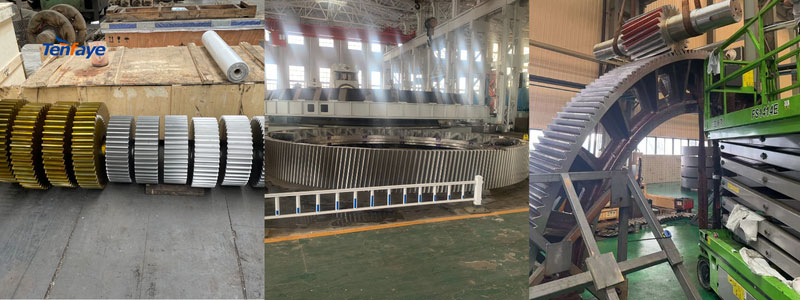
2. Precise Positioning during Installation and Commissioning
Installation accuracy directly determines the contact area and stress distribution of the gear pair; poor alignment will lead to localized stress concentration.
- Ensuring Optimal Backlash and Clearance: When installing the girth gear and pinion, the center distance must be adjusted strictly in accordance with the technical drawings to ensure that the backlash and top clearance fall within standard tolerance ranges.
- Meeting Contact Pattern Standards: Check the tooth surface contact pattern using the dye-staining method. The contact area should be no less than 40% along the tooth height and no less than 50% along the tooth length. Uneven contact can cause localized overloading, leading to premature spalling at the tooth edges.
- Eliminating Joint Errors in Split Girth Gears: For split-type (two-half) girth gears, assembly at the joint faces must ensure pitch tolerance and concentricity to avoid vibrations and structural impacts when the gears rotate across the joints.
3. Scientific Management during Operation and Daily Maintenance
Proper lubrication and regular inspections can significantly mitigate mechanical wear and prolong equipment operating cycles.
- Selecting Correct Lubricants and Application Methods: Due to the low speed and high torque of ball mills, high-viscosity heavy-duty open gear oils or lubricants containing molybdenum disulfide must be used. Automatic spray lubrication systems are highly recommended to apply the lubricant evenly, quantitatively, and periodically onto the tooth contact zones.
- Ensuring Proper Sealing and Dust Proofing: Dust and abrasive mineral particles entering the gear guard will form severe abrasive wear. The seals of the gear guard must be inspected regularly to prevent dust ingress, and accumulated sludge and debris at the bottom of the guard must be cleaned out periodically.
- Regular Temperature and Vibration Monitoring: Periodically measure the operating temperature of the tooth surfaces using infrared thermometers. A localized abnormal temperature spike typically indicates poor meshing or lubrication failure; immediate shutdown for troubleshooting is required to prevent high-temperature scuffing or adhesive wear on the teeth.
Conclusion
Extending the service life of a ball mill's girth gear and pinion requires a collaborative execution of premium casting, precise installation, and scientific lubrication. By enforcing rigorous material control and standardized routine maintenance, enterprises can effectively minimize unplanned downtime and save substantial costs on equipment replacements.
If you need to customize large-scale gear ring and pinions, Tenfaye can provide a formal quotation within 24 hours based on your engineering drawings!