
Home > Media > News

Mill Trunnion Head & Ball Mill End Cover:Common Pain Points & Solutions

Published:16:08 25 Jun, 2026

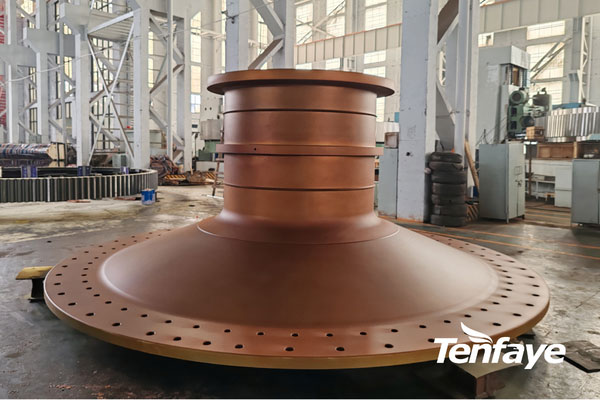
In cement spare parts, the mill Trunnion Head (integrated mill trunnion and end cover) used in heavy-duty grinding machinery such as Ball Mills and SAG Mills (Semi-Autogenous Grinding Mills) must simultaneously withstand hundreds of tons of rotational loads, continuous impacts from grinding media, and severe structural fatigue. As a critical load-bearing component of the mill, any cracking or deformation of the mill head will lead to catastrophic downtime and substantial financial losses for mineral processing plants or cement factories.
Below is an engineering analysis of common problems encountered during the casting and manufacturing of mill trunnion heads, along with precise technical solutions.

1. Internal Casting Defects (/Blowholes and Shrinkage Cavities)

Common Pain Points :

Due to the massive volume and non-uniform wall thickness of 1-150 ton trunnion heads, uneven cooling rates during the steel solidification process frequently lead to shrinkage cavities, blowholes, and micro-porosity at the internal flanges or thick sections. Under continuous alternating cyclic loading, these hidden internal defects act as stress concentration sites, eventually propagating into structural cracks and causing catastrophic split failures during operation.

Manufacturing Solutions :

  • CAE Casting Simulation : Prior to pouring, professional casting simulation software (such as MAGMA) is utilized to model the thermal balance and solidification path, enabling engineers to accurately optimize the placement of risers and chilling blocks to achieve directional solidification.

  • Molten Steel Refining & Purity : Utilizing advanced LF (Ladle Furnace) and VD (Vacuum Degassing) refining processes to strictly control hydrogen, oxygen, and other gaseous contents, as well as harmful residual elements, thereby maximizing the metallurgical purity of the molten steel.
  • 100% Non-Destructive Testing / NDT : Implementing comprehensive Ultrasonic Testing (UT) and Magnetic Particle Testing (MT) post-casting to guarantee that the internal structural integrity satisfies international standards (e.g., ASTM A609 Level II).
Ball Mill End Cover

2. Stress Concentration & Structural Fatigue Cracking

Common Pain Points:

The transition zone—where the cylindrical trunnion journal intersects with the vertical flange face of the end cover—experiences the maximum bending moments and shear stresses. If the transition radius fillet is poorly designed, or if residual casting stresses remain unmitigated, structural fatigue cracks will inevitably form along this joint area after extended operation.

Manufacturing Solutions :

  • Optimized Transition Fillet Radius : Enhancing the structural design by increasing the transition fillet radius at the junction of the journal and mill head, ensuring a smoother geometric transition to distribute operational stress evenly.

  • Strict Heat Treatment Regimen: Subjecting the rough casting to a precise, multi-stage Normalizing + Tempering heat treatment cycle post-machining. Controlling temperature holding times and cooling curves refines the grain structure and completely eliminates residual internal casting stresses.
  • Mechanical Property Testing : Conducting rigorous tensile, yield strength, and low-temperature impact toughness testing on attached test coupons cast alongside the main component to verify that all physical properties meet or exceed original equipment manufacturer (OEM) technical standards.


3. Machining Deviations & Misalignment

Common Pain Points :

Large ball mill end covers require exceptionally tight geometric and dimensional tolerances. Any deviation in concentricity or perpendicularity between the centerline of the main trunnion journal and the bolt-hole circle of the shell flange will cause rotational eccentricity. This eccentricity results in uneven bearing wear, overheating, oil film disruption, and excessive vibration, which accelerates premature damage to the large girth gear and pinion drive system.

Manufacturing Solutions :

  • Single-Setup Heavy-Duty CNC Vertical Lathe Machining : Utilizing ultra-large CNC vertical lathes to machine the journal outer diameter, end faces, and connecting flange face in a single clamping setup, fundamentally guaranteeing the coaxiality and perpendicularity of all critical surfaces.
  • Precision CNC Drilling: Utilizing high-precision CNC machining centers or specialized custom fixtures to drill the flange bolt holes that connect to the mill shell. This ensures perfect pitch-circle diameter (PCD) alignment and hole-spacing tolerances, preventing stress-induced forced assembly on-site.
  • Three-Dimensional Dimensional Inspection: Utilizing precision metrology tools (such as laser trackers or heavy-duty vernier calipers) to perform 3D dimensional and geometric tolerance verification after final machining, ensuring zero-error installation fitment.

Summary

Resolving the inherent pain points of large-scale mill trunnion heads relies strictly on "front-end thermal simulation, mid-stage steel refining and stress-relieving heat treatment, and back-end precision machining control." By enforcing rigid technical parameters at every phase, 1-150 ton heavy-duty trunnion heads can achieve an extended fatigue life and reliable operational stability under the most extreme mining and industrial conditions.

Need custom heavy steel castings? Send us your drawings and get a quote within 24 hours!

If you have any other questions, please feel free to contact whatsapp: +8618037881433 , you can also leave us message, we will warmly serve for you!

online

Whatsapp

8618037881433

Tel

8618037881433

Email

info@tenfaye.com