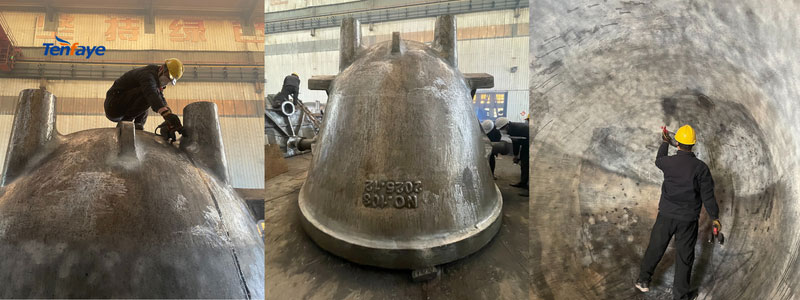
Quick SummarySlag pots crack mainly from 1300°C–1600°C thermal fatigue and internal casting defects. Tenfaye extends service life through 4 key optimizations:
- MAGMA 3D Simulation: Prevents internal shrinkage and porosity before pouring.
- LF/VD Secondary Refining: Pure, high-toughness alloy steel (GS-20Mn5 / ASTM A27).
- Full Heat Treatment: Normalizing + annealing to eliminate residual stress.
- 100% NDT Inspection: UT & MT testing ensures zero-defect, leak-proof delivery.
Custom 1–150t heavy cast steel slag pots with precision CNC machined trunnions.
Slag pots crack primarily due to intense thermal fatigue from 1300°C–1600°C molten slag combined with stress concentration around internal casting defects like shrinkage and porosity; extending service life requires MAGMA 3D casting simulation, LF/VD steel refining, stress-relieving heat treatment, and 100% NDT inspection.
As heavy-duty wear components in steelmaking, cast steel slag pots endure extreme thermal cycling and heavy loading. Unplanned bottom cracking, trunnion deformation, or slag leakage significantly increase replacement costs and compromise plant safety.
4 Core Causes of Slag Pot Cracking
Severe Thermal Fatigue
Rapid heating during molten slag pouring (1300°C–1600°C) and sudden cooling create massive expansion differentials between inner and outer walls. Over time, this cyclic thermal stress triggers fatigue cracking.
Internal Casting Defects
Subsurface shrinkage cavity, porosity, or inclusions act as stress concentration points where micro-cracks originate and expand under operational stress.
Uneven Wall Thickness & Stress Points
Abrupt structural transitions between the pot body, bottom, and trunnions build up severe thermal stress during solidification.
Incomplete Heat Treatment
Inadequate normalizing or annealing fails to relieve internal casting stresses, leading to premature cracking or structural failure during high-temperature operation.
4 Casting Optimizations to Extend Slag Pot Service Life
At Tenfaye Machinery, we optimize full-process manufacturing to eliminate cracking risks at the source:
1. MAGMA 3D Simulation to Eliminate Internal Defects
Before pouring, MAGMA numerical simulation models molten steel flow and solidification, allowing us to optimize gating/riser systems and achieve sequential solidification without internal shrinkage.
2. High-Purity Steel Refining & Optimized Alloys
Material Selection: High-toughness, low-carbon alloy steel grades (e.g., GS-20Mn5, ZG230-450, ASTM A27) are used to maximize high-temperature tensile strength and thermal fatigue resistance.
Secondary Refining: LF/VD ladle refining strictly controls sulfur (S) and phosphorus (P) impurities, significantly reducing cold shortness and hot tearing risks.
3. Normalizing + Annealing to Eliminate Residual Stress
Following shakeout and cleaning, slag pots undergo complete normalizing and stress-relief annealing in large heat-treating furnaces to refine grain structures and eliminate residual stresses.
4. 100% NDT Inspection for Zero-Defect Delivery
Critical load-bearing areas—including the pot bottom, transition zones, and trunnions—undergo Ultrasonic (UT) and Magnetic Particle (MT) testing to guarantee zero internal defects before shipment.
Precision Machining & Global Customization
1:1 Custom Manufacturing: Engineering 1 to 150-ton cast steel slag pots (10 to 30 m³ capacity) fully compliant with SMS group, Danieli, Primetals, or custom 2D/3D CAD drawings.
Heavy CNC Machining: Precision CNC boring and milling of trunnions ensure exact concentricity, smooth rotation, and safe crane handling.
About Tenfaye Machinery
Tenfaye specializes in manufacturing 1 to 150-ton heavy steel castings for the global steel, mining, and cement industries, producing custom slag pots, girth gears, rotary kiln tyres, and mill trunnions.
Need durable cast steel slag pots or custom replacement components for your plant?
Send us your technical drawings today for a fast quotation, or schedule a factory tour!