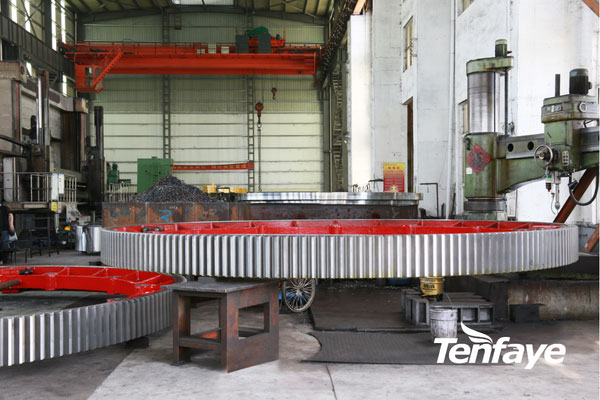
Quick Summary:Premature failure in cement and mining ball mill
cast steel girth gears—such as pitting, spalling, abnormal abrasive wear, or tooth breakage—is primarily caused by five key factors: lubrication failure, installation misalignment, severe overload impacts, internal casting defects (shrinkage/porosity), and improper heat treatment.
To prevent catastrophic gear downtime, plant engineers must adopt a strategy combining source manufacturing quality with routine predictive maintenance. Incorporating MAGMA solidification simulation, 100% UT/MT non-destructive testing (NDT), and precise heat treatment during production, paired with strict alignment and lubrication protocols in the field, can eliminate latent structural defects and extend girth gear service life by more than 50%.
1. Lubrication Failure & Abrasive Wear
Cause Analysis
Ball mills operate in harsh environments where cement dust and ore fines easily penetrate the gear guard. Inadequate sealing, incorrect oil viscosity, or uneven spray distribution leads to dry friction and severe abrasive wear, causing rapid tooth thinning and profile degradation.
Preventive Measures
- High-Performance Lubricants: Utilize high-viscosity, heavy-duty gear oils or specialized greases containing Extreme Pressure (EP) additives.
- Spray System Inspection: Regularly check automatic spray lubrication systems to ensure nozzles are unclogged and provide 100% face-width coverage.
- Dust Sealing & Oil Analysis: Upgrade gear guard dust seals and establish a routine oil sampling program to detect contamination early.
2. Girth Gear Misalignment & Installation Errors
Cause Analysis
Long-term shell deformation, foundation settlement, or poor initial installation tolerances induce severe edge loading between the girth gear and drive pinion. Excessive localized stress accelerates tooth edge wear and triggers bending fatigue cracks at the tooth root.
Preventive Measures
- Runout Tolerance Control: Strictly limit radial and axial runout during girth gear installation.
- Alignment & Contact Pattern Checks: Periodically recheck gear mesh clearances using laser alignment tools. Verify tooth contact patterns to ensure a minimum of 50% coverage along tooth height and 70% along tooth length.
3. Overload & Severe Impact Loads
Cause Analysis
Excessive grinding media (ball charge), large material blockages, or frequent direct-on-line starts subject the girth gear to instantaneous peak torque far beyond design limits, leading to bending fatigue and sudden tooth breakage.
Preventive Measures
- Feed & Ball Charge Control: Monitor feed size strictly and optimize ball charge ratios to prevent mechanical overloading.
- Soft-Start Integration: Equip drive trains with fluid couplings, variable frequency drives (VFDs), or soft starters to absorb startup shock loads smoothly.
4. Internal Casting Defects
Cause Analysis
For heavy cast steel girth gears (typically 3–8 meters in diameter), improper riser and gating design during pouring leads to internal shrinkage cavities, micro-porosity, gas holes, or slag inclusions. Under continuous cyclic stress, these hidden defects become crack initiation sites, resulting in sudden structural catastrophic failure.
Preventive Measures
- MAGMA Simulation at Source: Utilize MAGMA solidification simulation software prior to casting to optimize gating systems and eliminate thermal-center shrinkage.
- Tenfaye 100% NDT Inspection: Enforce strict 100% Ultrasonic Testing (UT) and Magnetic Particle Testing (MT) to ensure internal cast steel integrity meets ISO/ASTM defect-free standards.
5. Improper Material Selection & Non-Uniform Heat Treatment
Cause Analysis
Insufficient material tensile strength or unoptimized heat treatment (such as improper normalizing and tempering) results in low surface hardness (below required design thresholds) or non-uniform hardness distribution. This drastically reduces the gear's resistance to micropitting, scuffing, and fatigue.
Preventive Measures
- High-Strength Alloy Cast Steel: Select premium alloy cast steel grades such as ZG45CrMo, ZG42CrMo (or equivalent GS-34CrNiMo6 / ASTM A148).
- Full-Body Normalizing & Tempering: Apply full-body normalizing and tempering heat treatments to ensure high core impact toughness, superior tooth surface wear resistance, and uniform mechanical properties throughout the casting.
Conclusion & Actionable Advice
Maximizing ball mill girth gear longevity relies on a simple rule: "30% operational maintenance, 70% source manufacturing quality." Maintaining strict field lubrication and alignment while sourcing girth gears with certified NDT inspection reports and optimized material properties is the ultimate key to continuous, unscheduled-downtime-free plant operation.
Need Reliable Heavy Cast Steel Girth Gears?
[Contact our engineering team today] — We provide customized 1–150 ton heavy steel castings with full material traceability and RFQ responses within 24 hours!