
Published:10:39 04 Nov, 2026
A capable large steel casting manufacturer needs more than high-capacity melting equipment. It must have the technical expertise to control solidification, minimize internal defects, manage heat treatment deformation, and meet demanding machining requirements. Tenfaye manufactures custom large steel castings weighing 1–150 tons, supported by CAE casting simulation, ultrasonic testing, and customized production processes for heavy industrial applications.
When purchasing large steel castings, the size of a foundry's equipment is often the first thing buyers notice. A manufacturer may advertise the ability to pour castings weighing 50, 100, or even 150 tons. But can it consistently produce sound castings at that scale? Can it control internal shrinkage, maintain structural integrity, and ensure that a large component remains dimensionally stable after heat treatment and machining?
These are more important questions.
Large steel castings are used in cement plants, mining equipment, metallurgical machinery, power generation, and other heavy industrial applications. Components such as girth gears, mill end covers, bearing housings, slag pots, and turbine parts often operate under considerable mechanical and thermal loads. A manufacturing problem hidden inside the casting may not become visible until machining or, worse, during service.
So what should buyers look for when evaluating a large steel casting manufacturer?
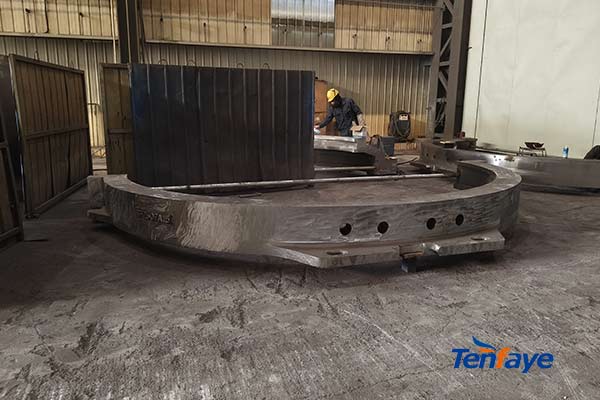
Producing a large steel casting is fundamentally different from pouring a small component on a larger scale.
As casting weight increases, the cooling process becomes more complicated. Thick sections retain heat for longer, while thinner areas cool much faster. This creates temperature differences across the casting and makes solidification control increasingly difficult.
The result can be internal shrinkage cavities, shrinkage porosity, inclusions, and other defects.
Consider a large bearing housing or mill end cover. Its thick structural sections and changing wall thicknesses create different cooling conditions throughout the mold. If the feeding system is not properly designed, some areas may not receive enough liquid metal during solidification.
This is why an experienced foundry does not simply increase the amount of molten steel and use a larger mold. It needs to understand how the entire casting will solidify.
CAE casting simulation helps engineers analyze metal flow, temperature distribution, and solidification behavior before production. Based on the simulation results, the gating and riser systems can be adjusted to improve feeding conditions and reduce the risk of internal defects.
For large steel castings, this preparation is particularly important because correcting a serious internal defect after pouring is often difficult or impossible.
A large steel casting manufacturer needs sufficient melting capacity to produce the required casting weight and material grade.
However, furnace tonnage alone does not tell the whole story.
Chemical composition, melting temperature, deoxidation, and pouring conditions all affect the quality of molten steel. Even when two foundries use furnaces of similar capacity, their results may differ because of how they manage the melting process.
For example, alloy steel castings require careful control of elements such as carbon, chromium, molybdenum, and manganese, depending on the specified grade. Deviations in chemical composition can influence strength, toughness, hardenability, and other mechanical properties.
For buyers, the important point is not simply how much steel a manufacturer can melt in one batch. It is whether the foundry can consistently produce the specified material and maintain traceable quality records.
One issue that deserves more attention is deformation during heat treatment.
Large steel castings often contain sections with significantly different thicknesses. During heating and cooling, these sections respond differently to temperature changes. Residual stress may also develop during solidification and subsequent cooling.
For components with large diameters, long dimensions, or relatively thin walls, even a small amount of deformation can create considerable problems during machining and assembly.
A turbine partition sleeve is a good example. Its large diameter and relatively thin wall make dimensional stability a major manufacturing concern. If the casting deforms during heat treatment, restoring the required geometry may involve additional machining, increased production costs, or even rejection.
The heat treatment process must therefore be considered as part of the overall casting plan rather than an independent operation.
At Tenfaye, large cast steel components are processed using heat treatment furnaces designed for heavy industrial castings. Heating and cooling arrangements are determined according to the casting material, structure, dimensions, and technical requirements.
The objective is not simply to achieve the specified hardness or mechanical properties. It is also to maintain the structural and dimensional conditions needed for subsequent machining.
Visual inspection is necessary, but it cannot reveal every defect in a large steel casting.
Surface defects may be identified through visual inspection and appropriate surface testing. However, internal shrinkage, porosity, and other discontinuities require suitable internal inspection methods.
Ultrasonic testing (UT) is particularly important for inspecting the internal quality of large steel castings. It helps detect internal discontinuities that may not be visible on the surface.
For critical components, inspection requirements should be agreed upon before production. Buyers should clarify:
Which areas require ultrasonic testing?
What acceptance criteria apply?
Is a material test report required?
Are mechanical property tests included?
What inspection records will be supplied with the finished casting?
At Tenfaye, ultrasonic testing and other inspection methods are applied according to product specifications and customer requirements. Combined with CAE casting simulation, these measures help identify and reduce the risk of internal quality problems.
It is worth understanding one distinction: simulation helps optimize the manufacturing process, while inspection evaluates the actual casting. Neither should be treated as a replacement for the other.
A casting may pass its initial inspection but encounter problems when it reaches the machining stage.
For example, a large bearing housing may require precise bearing seat dimensions and alignment. A girth gear blank needs sufficient machining allowance and a suitable casting structure to support subsequent machining operations.
If the casting contains excessive deformation or unexpected internal defects, machining may expose problems that were not apparent earlier.
This is why machining requirements should influence casting design and production from the beginning.
A capable large steel casting manufacturer needs to understand the final component, not just the raw casting. It should consider:
Machining allowances on critical surfaces.
Reference surfaces and datum positioning.
Dimensional tolerances specified in drawings.
Potential deformation during machining.
Inspection requirements after machining.
Tenfaye produces custom large steel castings according to customer drawings and technical specifications, with machining arrangements based on the component's requirements.
The goal is to ensure that the casting is prepared for its intended machining and final application rather than treated as an isolated foundry product.
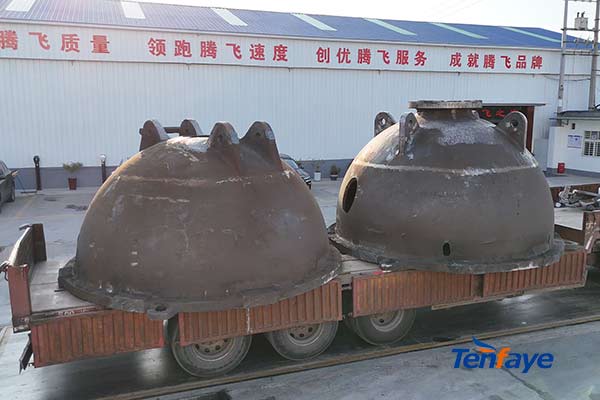
A foundry's maximum casting weight is an important reference, but it should not be the only factor in supplier evaluation.
A manufacturer may be capable of pouring a very heavy casting but lack experience with complex structures, difficult material grades, or components requiring strict dimensional control.
Buyers should look beyond the maximum tonnage and examine the manufacturer's actual production experience.
For example, manufacturing a 100-ton simple structural casting presents different challenges from producing a 30-ton component with complex internal geometry, thick-to-thin transitions, and demanding machining tolerances.
When evaluating a supplier, it is useful to ask for:
Examples of previously manufactured castings with similar structures and weights.
Experience with the specified material grade.
Available melting and heat treatment capacity.
Casting simulation and inspection capabilities.
Experience with machining large and complex components.
Quality documentation and inspection records.
At Tenfaye, large steel castings weighing from 1 to 150 tons can be manufactured according to customer drawings. The product range covers components used in cement, mining, metallurgical, power generation, and other heavy industrial sectors.
The actual manufacturing route is determined by the casting structure, material, weight, and technical requirements of each project.
Price and delivery time are important, but they do not provide a complete picture of manufacturing capability.
A low quotation may become expensive if the casting requires repeated repairs, additional machining, or replacement due to quality problems.
Before placing an order, buyers should provide the supplier with the component drawings, material specifications, estimated weight, required inspection standards, and machining requirements.
The following questions can help establish whether a foundry is suitable for the project:
Can the manufacturer produce the required casting weight?
Check its actual melting capacity, molding facilities, and experience with similar castings.
How does it control internal casting defects?
Ask whether CAE simulation, suitable feeding design, and internal inspection methods are available.
Can it handle large-component heat treatment?
Confirm that the furnace dimensions and process arrangements are suitable for the casting.
Does it understand the final machining requirements?
A manufacturer should be able to consider machining allowances and critical dimensions before production begins.
Can it provide inspection documentation?
Discuss material certificates, mechanical testing, dimensional reports, and NDT records before production rather than waiting until delivery.
These discussions can help avoid misunderstandings and make supplier evaluation more practical.
Founded in 2003, Tenfaye is a large steel casting manufacturer based in Huixian, Xinxiang, Henan, China.
With a production area of approximately 100,000 m² and more than 300 employees, the company focuses on custom cast steel components for heavy industrial applications.
Its manufacturing capabilities include:
Casting weight: 1–150 tons.
Materials: Carbon steel, low-alloy steel, and stainless steel.
Production Equipment: Comprehensive casting, heat treatment, machining, and inspection equipment for large steel casting manufacturing.
Process support: CAE casting simulation and customized process planning.
Quality inspection: Ultrasonic testing, magnetic particle testing, and other inspection methods according to requirements.
Quality documentation: Material inspection and EN 10204 3.1 documentation when specified.
Customization: Manufacturing according to customer drawings and technical specifications.
Tenfaye manufactures large industrial components including girth gears, ball mill end covers, bearing housings, rolling mill chocks, slag pots, valve bodies, and turbine components.
For projects involving heavy cast steel components, the company works with customers to determine suitable materials, casting processes, inspection requirements, and machining arrangements based on the actual application.
Have a large steel casting project in mind?
Send your drawings and technical requirements to Tenfaye for a factory quotation.
The maximum casting weight depends on the foundry's melting, molding, pouring, and handling capabilities. Tenfaye can manufacture custom steel castings weighing from 1 to 150 tons according to customer drawings and technical requirements.
CAE casting simulation helps optimize the feeding system and reduce the risk of internal shrinkage and porosity. Ultrasonic testing (UT) can help detect internal discontinuities and evaluate casting quality according to specified inspection requirements.
Buyers should provide technical drawings, material grade, estimated weight, required quantity, dimensional tolerances, inspection standards, and machining requirements. These details help the manufacturer evaluate the production process and prepare an accurate quotation.
If you have any other questions, please feel free to contact whatsapp: +8618037881433 ,
you can also leave us message, we will warmly serve for you!