
Published:17:43 26 Aug, 2026
Girth gears are key components in the drive systems of ball mills and rotary kilns. Their service life does not have a fixed number of years. It depends on factors such as material, manufacturing quality, equipment load, alignment, lubrication, and maintenance. Regular inspection can help reduce early failure and unexpected downtime.
Girth gears for ball mills and rotary kilns work under heavy loads for long periods. Their service life can vary depending on the equipment size and operating conditions.
For example, large cement rotary kilns usually run at low speed and under heavy loads. Ball mills can also create high loads and impact during startup and grinding.
Therefore, the service life of a girth gear should not be judged only by its operating years. Tooth wear, gear contact, and overall condition are also important.
Material and Manufacturing Quality
Girth gears work under repeated loads and constant tooth contact. Material strength, hardness, and manufacturing quality all affect wear resistance and fatigue life.
For large cast steel girth gears, casting quality and heat treatment are important. Proper non-destructive testing is also needed to check for internal defects and ensure product quality.
Equipment Load and Operating Conditions
Long-term overload can increase the contact pressure between the girth gear and pinion.
Frequent starts, impact loads, and unstable operating conditions can also increase tooth wear.
Installation and Gear Alignment
Correct installation and proper alignment between the girth gear and pinion are very important.
Poor alignment can cause uneven tooth contact. Some areas of the gear teeth may carry too much load, which can lead to local wear, pitting, or even cracks.
Good lubrication reduces friction and heat between the gear teeth and helps slow down wear.
Poor lubrication, the wrong lubricant, or insufficient maintenance can shorten girth gear service life.
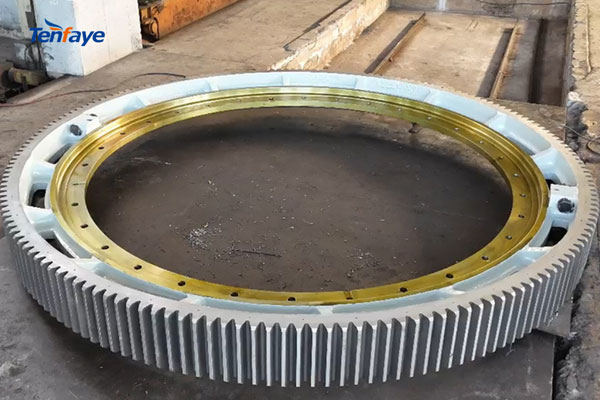
During regular inspection, the girth gear should be checked if you notice:
These signs do not always mean the girth gear needs to be replaced immediately. However, they show that further inspection is needed.
A girth gear may need to be replaced when it has severe tooth wear, cracks, broken teeth, or other damage that cannot be solved through maintenance and the damage affects safe operation.
For large ball mills and rotary kilns, girth gear replacement usually involves manufacturing, transportation, installation, and alignment. Therefore, it is better to plan the replacement before a serious failure occurs.
Early inspection and proper replacement planning can help reduce the risk of unexpected downtime.
For customers planning a replacement, Tenfaye can manufacture custom girth gears based on equipment models, drawings, gear dimensions, and existing gear specifications. This helps ensure proper compatibility with the existing pinion and drive system.
The following steps can help extend girth gear service life:
The service life of a girth gear depends on many factors, including design, material, manufacturing, installation, operation, and maintenance. Instead of focusing only on how many years a girth gear can run, regular inspection and early detection of wear are more important.
For cement plants, mining companies, and other industrial users looking for a replacement or custom girth gear, the right solution can be selected based on the equipment model, gear dimensions, drawings, or existing gear specifications.
Looking for a reliable girth gear supplier for your ball mill or rotary kiln? Tenfaye provides custom girth gears for cement plants, mining operations, and other heavy-duty applications. Send us your gear drawing, dimensions, or equipment model, and our engineers can review your requirements and recommend a suitable solution.
If you have any other questions, please feel free to contact whatsapp: +8618037881433 ,
you can also leave us message, we will warmly serve for you!