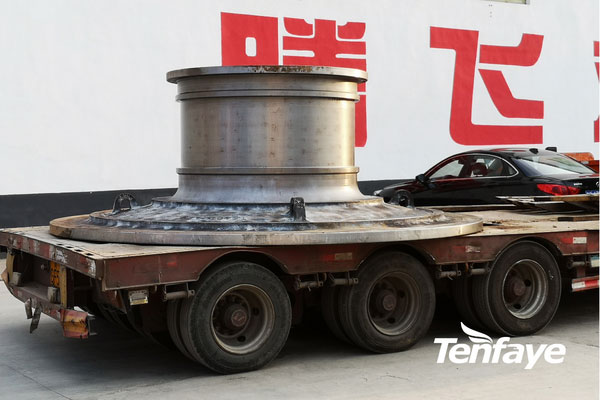
Quick Summary:
Ball mill end covers primarily use carbon cast steel and low-alloy cast steel. ZG270-500 (ASTM A148 Grade 80-50) is the most widely used grade due to its excellent overall mechanical properties, making it suitable for most medium-to-large mills. For ultra-large or heavy-duty operating conditions, chromium-molybdenum alloy cast steels such as ZG35CrMo or ZG42CrMo are preferred to enhance impact toughness and resistance to fatigue cracking.
Common Cast Steel Materials for Ball Mill End Covers (Mill Heads)
In industries such as mining, cement, metallurgy, and building materials, the ball mill end cover serves as a critical load-bearing component. It supports the shell weight, transmits massive torque, and withstands heavy impacts as well as alternating stresses. Consequently, material selection directly affects operational safety and equipment service life. Large, heavy-duty ball mill end covers are universally made of cast steel rather than cast iron due to cast steel's superior tensile strength, impact toughness, and weldability/repairability.
I. Core Carbon Cast Steel
Carbon cast steel is the most widely used and cost-effective material for medium-to-large ball mill end covers, offering good ductility, toughness, and machinability.
ZG230-450 (Equivalent to ASTM A27 Grade 65-35 / DIN GS-45)
- Performance Characteristics: Low-carbon cast steel featuring excellent toughness and superior weldability. Normalizing heat treatment effectively eliminates internal stresses to prevent cracking.
- Applications: Small-to-medium ball mill end covers and operating conditions with relatively uniform load distribution without extreme impact (e.g., cement raw mills, small-to-medium mining mills).
ZG270-500 (Equivalent to ASTM A148 Grade 80-50 / DIN GS-52)
- Performance Characteristics: Medium-carbon cast steel and the most standard material used for large ball mill end covers. Compared with ZG230-450, its yield strength and tensile strength are significantly improved while maintaining excellent overall mechanical properties.
- Applications: Main end covers and trunnions of heavy-duty ball mills and regrind mills, effectively resisting long-term bending stress and fatigue caused by shell rotation.
II. Low-Alloy High-Strength Cast Steel — For Ultra-Large & Heavy-Duty Applications
As mineral processing equipment scales up (e.g., ultra-large ball mills over 5 meters, SAG mills), standard carbon steels struggle to meet requirements under extreme impacts and thick cross-sectional hardenability. Low-alloy cast steels have thus become the premium specification.
ZG310-570 / ZG340-640 (High-Strength Alloyed Steel)
- Performance Characteristics: Through micro-alloying or adjusting the carbon-manganese ratio, the yield point and tensile strength are substantially increased, offering superior wear resistance and deformation resistance.
- Applications: Large heavy-duty ball mills and end cover regions subjected to significant axial thrust and material impacts at the discharge end.
ZG35CrMo / ZG42CrMo (Chromium-Molybdenum Alloy Cast Steel)
- Performance Characteristics: Alloyed with Chromium (Cr) and Molybdenum (Mo), and subjected to quenching and tempering (Q&T) heat treatment, these steels deliver exceptional strength, superior hardenability, high impact toughness, and extreme fatigue resistance.
- Applications: Large SAG mills, ultra-large overflow ball mills, and critical end cover components operating long-term in harsh mining environments with heavy overloads and impacts.
III. Comparison of Common Cast Steel Materials
The table below summarizes the mechanical properties and application focus of mainstream cast steel grades:
| Steel Grade (GB Standard) |
International Equivalent (ASTM) |
Tensile Strength (MPa) |
Yield Strength (MPa) |
Primary Advantages |
Recommended Applications |
| ZG230-450 |
ASTM A27 Grade 65-35 |
≥ 450 |
≥ 230 |
Excellent toughness,good weldability, low cost |
Small-to-medium mills, light-duty cement mill covers |
| ZG270-500 |
ASTM A148 Grade 80-50 |
≥ 500 |
≥ 270 |
Best overall mechanical properties, high fatigue resistance |
Large/medium mining ball mill covers (Industry Standard) |
| ZG310-570 |
ASTM A148 Grade 90-60 |
≥ 570 |
≥ 310 |
High load capacity, outstanding deformation resistance |
Large heavy-duty ball mill covers |
| ZG35CrMo |
ASTM A148 Grade 105-85 |
≥ 685 |
≥ 490 |
Exceptional strength & impact toughness, fatigue resistant |
Ultra-large SAG mills, heavy-duty mining mil |
IV. Cast Steel vs. Ductile Iron: How to Choose?
While ductile iron (e.g., QT600-3) end covers are occasionally used in smaller machinery, cast steel holds irreplaceable advantages for heavy ball mills weighing from 10 tons up to 150 tons:
- Cracking Resistance & Fracture Toughness: Cast steel possesses far higher fracture toughness than ductile iron. When subjected to violent impacts from grinding media (steel balls) and ore, cast steel is far less prone to catastrophic brittle fracture.
- Defect Repairability: Heavy casting processes occasionally produce minor internal imperfections. Cast steel offers excellent weldability, allowing standardized excavation and weld repairs (with preheating and post-weld stress relief) to restore 100% structural integrity. Conversely, welding ductile iron easily causes hard white iron structures and micro-cracks.
- Residual Stress Relief: Large steel castings can undergo full normalizing and tempering heat treatments to completely eliminate internal casting stresses, ensuring long-term dimensional stability without deformation.
Request a Quote
If you need to source custom large-scale ball mill end covers or other heavy steel castings (1-150 tons), feel free to contact us. We will provide a competitive quotation within 24 hours!