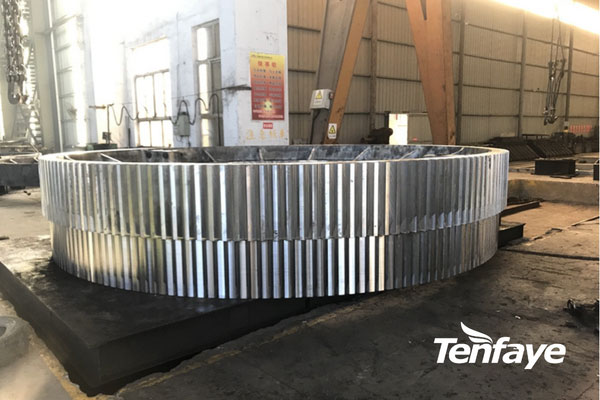
Rotary kiln girth gear service life years cement plant are influenced by multiple factors including operating conditions, material quality, and maintenance practices. As the key transmission cast steel component of the rotary kiln — a core thermal processing equipment — the typical lifespan of cement kiln girth gear years has always been a top concern for maintenance professionals in the cement, metallurgy, mining, chemical, and sugar industries, directly impacting production line continuity and economic efficiency.
1. Typical Lifespan of Cement Kiln Girth Gear Years
Under ideal conditions — proper design, precise installation, adequate lubrication, and stable load — the typical lifespan of cement kiln girth gear years varies by manufacturing method:
Forged girth gears: 10–15 years
Cast girth gears (bull gears): 6–8 years
However, in real-world operation, rotary kiln girth rings operate under high temperature, heavy load, and dusty environments, making wear, fatigue, and deformation unavoidable. Industry statistics show that the rotary kiln girth gear service life years cement under normal conditions is:
Forged ring gears: 8–12 years
Cast large gear rings: 3–6 years
2. Six Key Factors Affecting Rotary Kiln Girth Gear Service Life
2.1 Material & Heat Treatment
Kiln girth gears are typically made from alloy cast steels such as ZG35SiMn or ZG42CrMo, followed by quenching, tempering, or surface hardening. The purity of the material, casting defects (porosity, cracks), and hardness uniformity directly determine the gear's fatigue resistance and wear performance.
2.2 Installation Accuracy
Radial runout, end face runout, and meshing clearance between the girth gear and pinion must be strictly controlled. Excessive deviation causes uneven wear and impact loads, accelerating tooth surface spalling.
2.3 Lubrication Condition
Poor lubrication is the leading cause of premature girth gear failure. Open gear drives typically use spray lubrication. Oil viscosity, spray volume, frequency, and cleanliness are all critical. Interrupted lubrication or contaminated oil can cause severe wear or scuffing in a short time.
2.4 Kiln Shell Alignment
Over time, the rotary kiln shell may bend or shift, causing uneven load distribution on the girth gear. Regular measurement and adjustment of the shell centerline is essential to protect the large gear ring.
2.5 Ambient Temperature & Dust
High-temperature radiation near the kiln hood and tail reduces material strength, while dust entering the mesh zone accelerates abrasive wear.
2.6 Operation & Maintenance Practices
Frequent starts/stops, rapid acceleration/deceleration, and overload operation impose additional shock loads on the girth gear. A scientific inspection and maintenance schedule is fundamental to extending service life.
3.How to Extend Rotary Kiln Girth Gear Service Life ?
|
Maintenance Item |
Recommended Frequency |
Key Points |
|
Tooth surface visual inspection |
Weekly |
Check for cracks, pitting, plastic deformation |
|
Lubrication system check |
Per shift |
Confirm pump pressure, nozzle condition |
|
Backlash & contact pattern check |
Quarterly |
Use pinion coating method to check contact pattern |
|
Kiln shell alignment measurement |
Annually |
Adjust support rollers if misalignment found |
|
Girth gear bolt torque check |
Semi-annually |
Prevent bolt loosening and gear displacement |
Additionally, during major overhauls, perform ultrasonic testing or magnetic particle inspection on the girth gear to detect internal micro-cracks and prevent sudden fracture.
4. When Should You Replace the Girth Gear?
Consider replacement when any of the following conditions occur:
- Tooth thickness wear exceeds 20%–25% of the original value.
- Large-area deep spalling or through cracks appear on the tooth surface.
- Obvious plastic deformation of the gear body that cannot be corrected by adjustment.
- Multiple weld repairs have degraded base material properties due to heat-affected zone accumulation.
While the investment cost of a rotary kiln girth gear is significant, its service life is not uncontrollable. Through proper material selection, precise installation, standardized lubrication, and regular inspection and maintenance, the typical lifespan of cement kiln girth gear years can reliably exceed 15 years, delivering greater economic benefits to your plant.
If you are experiencing premature girth gear wear or need assistance with selection, please contact our technical team for a tailored solution.Tenfaye specializes in the production of rotary kiln girth gears, pinions, support rollers, thrust rollers, and other large cast steel components. With advanced heat treatment and machining capabilities, our products serve cement, metallurgy, and mining industries worldwide. Visit our website or contact our sales team for more information.