
Published:16:58 20 Oct, 2026
A girth gear is the large ring gear that wraps around the shell of a rotary kiln, ball mill, or industrial dryer. Driven by a pinion from the main motor, it turns the entire vessel — slowly, under full load, often around the clock. When a girth gear fails, the whole line stops. There is no backup.
That is why cement plants, mines, and OEMs treat the girth gear as one of the most critical components in the drive system, and why so many buyers choose cast steel for gears of this size.
Tenfaye is a steel casting manufacturer in Henan, China, founded in 2003. Across a 100,000 m² plant with more than 400 employees, we produce custom steel castings from 1 to 150 tons for cement, mining, metallurgy, and other heavy industries. Our customers include POSCO, Metso, FLSmidth, LafargeHolcim, Thyssenkrupp, Loesche, and Baowu Steel.
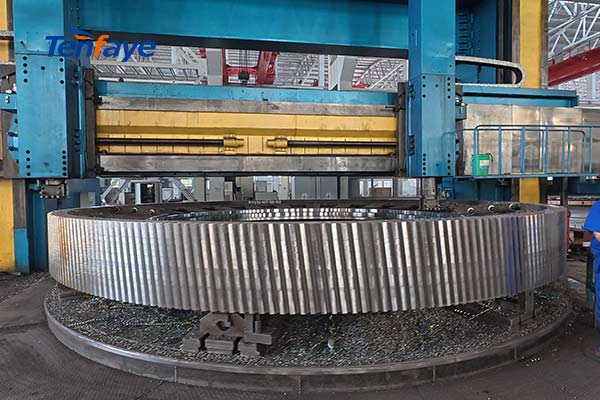
A girth gear — also called a gear ring, ring gear, or bull gear — is a large-diameter gear mounted on the circumference of a rotating shell. It meshes with a smaller pinion driven by the motor and gearbox, transferring torque to the vessel.
Girth gears are built either as a single ring or in segments. Segmented designs (two halves, four pieces, or more) are common on very large kilns and mills because they are easier to transport and install. The trade-off is that every joint face must be machined and aligned precisely; a joint error shows up later as uneven tooth contact and accelerated wear.
Most girth gears are spur gears with straight teeth, though helical designs are used where smoother engagement is needed.
Cement kilns, lime kilns, and pelletizing drums run continuously at low speed under high torque and thermal stress. The girth gear must keep the shell turning evenly through decades of service. Replacement gears for existing kilns must match the original installation dimensions, tooth geometry, and mounting arrangement exactly.
In mining and cement grinding, ball mills subject their girth gears to heavy loads and repeated impact cycles. Material selection, tooth accuracy, lubrication, and alignment decide how long the gear lasts. A replacement gear must also mesh correctly with the existing pinion — which is why drawing-based manufacturing matters more than any catalog size.
Industrial dryers, rotary coolers, SAG and rod mills use girth gears with widely varying diameters, modules, and speeds. Nearly all of them are custom projects, manufactured to the original equipment design rather than to any standard series.
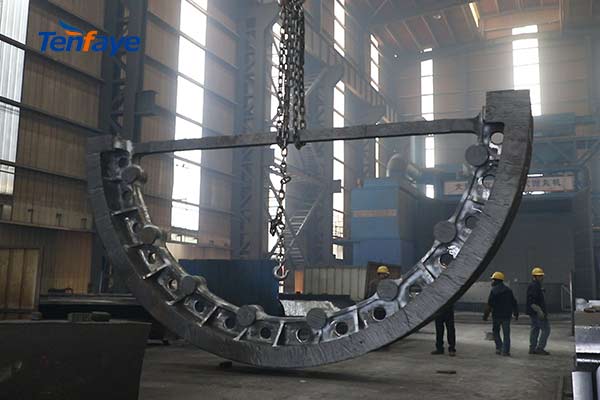
For gears in the multi-meter diameter range, cast steel is usually the most practical route. Casting handles large dimensions and complex, heavy-section geometry that would be difficult or prohibitively expensive to forge. Common girth gear cast steel grades include ZG45, ZG310-570, ZG42CrMo, and ZG35CrMo; European drawings often specify GS34CrMo4 or comparable grades.
Whatever grade your drawing calls for, we melt to the specified composition — verified with an OBLF spectrometer before and after pouring — so the material certificate matches the requirement, not the other way around.
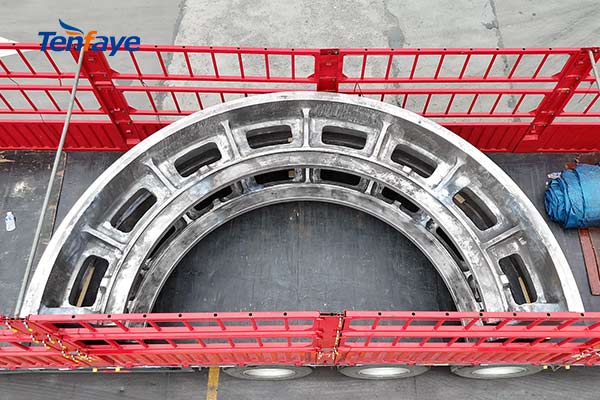
Every project starts with your drawings. We review gear diameter, face width, module, number of teeth, material grade, segment configuration, and tolerances, together with the mounting structure and its relationship to the pinion. Before the pattern is made, the casting process is simulated with CAE software to predict filling and solidification and optimize riser placement — on a casting this large, getting solidification right the first time is what keeps defects out and lead times short.
The gear is melted in our 25-ton electric arc furnaces with ladle refining, then poured and managed through controlled solidification. Mould design, pouring temperature, and section-by-section cooling are planned around the gear's geometry to prevent shrinkage and internal defects. Molten steel composition is checked by spectrometer at multiple stages, from furnace to cast state.
After casting, the gear is normalized or quenched and tempered in our natural gas-fired heat treatment furnaces to hit the specified mechanical properties. Uniform temperature across a component this size demands furnaces with enough capacity and careful thermocouple control — one of the reasons buyers audit heat treatment facilities before placing an order.
Machining covers mounting surfaces, bolt holes, joint faces, and the gear teeth themselves, on our 10-meter vertical lathes and large gear hobbing machines. Tooth geometry, radial runout, and joint dimensions are checked against the approved drawing and the specified accuracy standard.
Inspection follows the drawing, material specification, and purchase order, under our national Level II flaw detection standard. Depending on the project, this includes:
Inspection methods and acceptance criteria are agreed before production starts. EN 10204 3.1 inspection certificates and full test reports are supplied with delivery when specified in the order.
|
Item |
Range / Options |
|---|---|
|
Casting weight |
1–150 tons |
|
Structure |
One-piece or segmented (2, 4, or more segments) |
|
Tooth form |
Spur; helical on request |
|
Material |
ZG45, ZG310-570, ZG42CrMo, ZG35CrMo, or per your specification |
|
Heat treatment |
Normalizing, quenching & tempering, as specified |
|
Tooth accuracy |
Per AGMA / DIN / ISO grades, as specified on the drawing |
|
NDT |
UT, MT, PT (Level II acceptance standard) |
|
Supply condition |
Cast blank, rough-machined, or finish-machined with cut teeth |
Most girth gear projects are replacements for equipment already in the field. If the original drawing is available, send it — 2D drawings or 3D models both work. If not, we can start from:
Measuring a worn gear takes some care — module and tooth profile are best taken with proper gear gauges rather than calipers. If your measurements look uncertain, tell us; we will advise on what to check before cutting steel.
A well-made cast steel girth gear on a properly aligned drive typically runs 20–30 years, and kiln gears often outlast the pinions that drive them. The most common causes of early failure are misalignment, poor lubrication, and casting or heat treatment defects — which is why inspection records matter.
Watch for pitting and spalling on the tooth flanks, abnormal backlash growth, cracked teeth (especially near segment joints), and visible wear steps at the pitch line. Cracked teeth on a loaded gear are a safety issue — plan the replacement before a failure takes the gear and the pinion out together.
For gears of this diameter, cast steel is usually the most economical choice with fully adequate strength. Forging is generally impractical at girth gear sizes because of the equipment involved. The right answer depends on the operating load, speed, and your specification — send us the drawing and we will review it.
Yes. Segmented gears (two halves, four segments, or more) are standard practice for large diameters and restricted transport routes. Joint faces are machined for bolted assembly, and every segment is match-marked so the field crew can reassemble them in the correct orientation.
Yes. We manufacture pinions and pinion shafts to your drawings so the gear pair is engineered to work together — the safest option for a replacement project.
Tooth accuracy follows the specification on your drawing — commonly AGMA or DIN grades. Tell us the required grade when requesting a quotation and we will confirm the machining route to achieve it.
It depends on diameter, weight, and machining scope. Casting and heat treatment of a very large girth gear cannot be rushed, so realistic planning matters. Tell us your shutdown window early and we will build the schedule around it.
At minimum: the application (kiln, ball mill, dryer), main dimensions, gear specifications (module, number of teeth), material grade, manufacturing scope, quantity, and delivery requirements. Drawings are best; if unavailable, see the measurement guidance above.
Send your drawings, material specifications, and technical requirements to Tenfaye, and our engineering team will review them and return a factory quotation. If you are planning a replacement during a shutdown, mention your window and we will confirm whether the schedule is realistic before you commit.
If you have any other questions, please feel free to contact whatsapp: +8618037881433 ,
you can also leave us message, we will warmly serve for you!