
Published:17:33 19 Aug, 2026
Quick Overview
Choosing the right ball mill girth gear depends on mill specifications, gear size, module, material, load capacity, and pinion compatibility.For replacement projects, provide your drawing, dimensions, technical specifications, or photos to help the manufacturer recommend the right solution.
A Girth Gear is a critical component of a ball mill's drive system. It meshes with the pinion to transfer power to the mill shell. For large ball mills used in cement, mining, metallurgy, and mineral processing, selecting the right girth gear is essential for stable operation, reduced wear, and extended service life.
So, what factors should you consider when selecting a girth gear for a ball mill?
First, you need to understand the basic parameters of the ball mill, including:
Ball mill model and dimensions
Motor power
Mill speed
Operating torque
Production capacity
Operating hours
Material being processed
Operating environment
These parameters directly determine the load and power transmission requirements of the girth gear.
Diameter, number of teeth, and module are the core design parameters of a girth gear.
The pitch diameter is generally related to the module and number of teeth:
Pitch Diameter ≈ Module × Number of Teeth
Actual gear design also needs to consider the pressure angle, tooth profile, transmitted power, and pinion specifications.
For a replacement girth gear, it is especially important to ensure that the new gear is properly matched with the existing pinion. Providing the original gear drawing or technical specifications is recommended to avoid abnormal wear and vibration caused by incompatible gear parameters.
Face width determines how the load is distributed across the gear teeth.
Insufficient face width may result in higher tooth contact stress and localized wear, while excessive face width can increase the weight and manufacturing cost of the girth gear.
Therefore, face width should be designed according to the transmitted power, operating torque, module, material, and actual operating conditions.
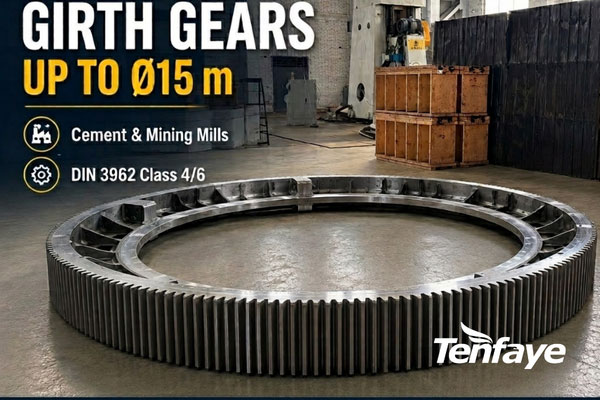
Material directly affects the strength, toughness, wear resistance, and service life of a girth gear.
Common materials for large industrial girth gears include:
ZG45
ZG35CrMo
42CrMo
45# steel
For large girth gears, material grade is only one consideration. Raw material quality, casting or forging process, heat treatment, and non-destructive testing are also important.
Internal defects such as porosity, shrinkage, inclusions, or cracks can reduce the reliability of the gear, making manufacturing quality equally important.
Large girth gears can be manufactured using different processes depending on their size, load, and operating conditions.
Cast steel girth gears are widely used in large industrial ball mills and offer advantages for manufacturing large and complex components.
Forged steel girth gears may be preferred for applications requiring higher material integrity and mechanical properties.
The final choice should be based on gear size, load requirements, material specifications, and operating conditions rather than simply comparing purchase prices.
The Girth Gear must properly mesh with the pinion. Key parameters that need to match include:
Module
Pressure angle
Number of teeth
Tooth profile
Face width
Center distance
Gear accuracy
The dimensional accuracy, runout, and segment joint accuracy of the girth gear must also be properly controlled.
If the girth gear is improperly aligned after installation, it may cause abnormal noise, vibration, localized wear, or even tooth breakage.
If you are looking for a replacement girth gear for your ball mill, it is recommended to provide the manufacturer with:
Girth gear dimensions
Number of teeth and module
Face width
Material requirements
Pinion specifications
Motor power
Original girth gear drawing
Photos of the existing girth gear
The more complete the technical information, the more accurately the manufacturer can evaluate your requirements and prepare a quotation.
Selecting the right Girth Gear requires careful consideration of the ball mill specifications, transmitted power, operating torque, gear dimensions, module, face width, material, gear accuracy, and pinion compatibility.
For replacement projects, the most important consideration is ensuring that the new girth gear is fully compatible with the existing ball mill and drive system.
Send us your drawings, technical specifications, dimensions, or photos of your existing girth gear.
The Tenfaye engineering team can evaluate your requirements based on your equipment specifications and provide a customized Girth Gear solution and factory quotation.
If you have any other questions, please feel free to contact whatsapp: +8618037881433 ,
you can also leave us message, we will warmly serve for you!