
Published:17:48 27 Oct, 2026
Large steam turbine partition sleeves require more than a sound casting. The condition of the casting before machining can influence how much material remains available for finishing, how machining operations are planned, and whether the finished component can meet the dimensions specified in the drawing.
For large cast steel components, these issues are closely connected. Solidification, cooling, heat treatment and machining all affect the manufacturing process, so they need to be considered together rather than as isolated steps.
A large ring-shaped casting does not necessarily cool or contract uniformly throughout its section. Differences in wall thickness, local geometry and cooling conditions can create variations in shrinkage. Depending on the casting structure and process conditions, these variations may contribute to dimensional distortion.
The challenge becomes more significant when a component has a large diameter or an uneven cross-section. A small dimensional change in the casting can affect the amount of material available for subsequent machining, particularly around surfaces that must meet specific dimensional or geometric tolerances.
This does not mean that every large steam turbine partition sleeve will experience serious deformation. The actual risk depends on the component's geometry, material, casting process and heat treatment requirements. The drawing and technical specification therefore provide the starting point for assessing manufacturing requirements.
Machining allowance is the material intentionally left on a casting so that subsequent machining can produce the required final dimensions and surface condition.
For a large cast steel partition sleeve, the allowance cannot be considered independently of the casting's geometry and expected dimensional changes. Too little material in a critical area may leave insufficient stock for finishing if the casting deviates from its intended shape. Excessive allowance, on the other hand, increases the amount of material that must be removed and can add machining time.
The appropriate allowance depends on factors such as the component's dimensions, section thickness, casting process, machining requirements and applicable tolerances. There is no single allowance that can be applied to every partition sleeve.
The distinction between the casting drawing and the finished-part drawing is also important. Surfaces that will be machined need to be identified, and the relationship between the casting condition and the final dimensions must be understood before production begins.
For OEM buyers, providing the complete drawing package and specifying which dimensions and surfaces are critical helps the manufacturer assess the casting and machining requirements more accurately.
Heat treatment is another factor that may influence the dimensional condition of a cast steel component. Heating and cooling can introduce dimensional changes, and the extent depends on the material, section geometry and treatment cycle.
For this reason, the manufacturing sequence matters. The condition of the casting after heat treatment may affect the stock available for machining and the approach needed to achieve the final dimensions. Where dimensional stability is a concern, the relevant requirements should be considered when planning the production route.
The specific heat treatment method must follow the material specification and the component's technical requirements. It should not be selected solely because the part is large or ring-shaped. Material grade, required mechanical properties and applicable standards all need to be taken into account.
Dimensional checks at appropriate stages can help establish whether the component remains suitable for the next operation. The inspection plan and acceptance criteria, however, should be defined according to the drawing and agreed technical documentation rather than assumed to be identical for every project.
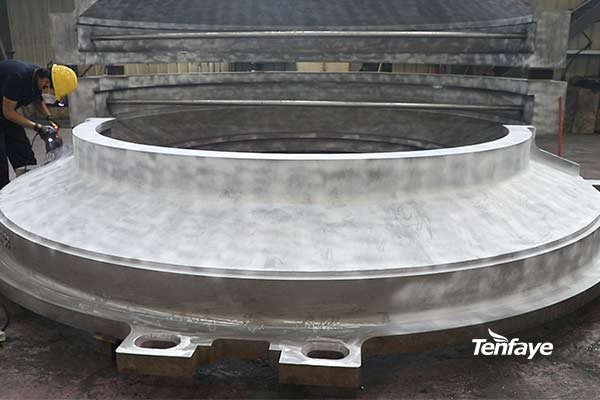
Casting and machining are different manufacturing operations, but the final result depends on how well their requirements are coordinated.
A casting may appear acceptable in its initial condition while still requiring careful assessment of machining stock, reference surfaces and the dimensions that must be achieved after material removal. The machining sequence also needs to account for the component's geometry and the requirements of the finished part.
For large steam turbine partition sleeves, the key questions are practical:
Which surfaces must be machined to meet the drawing requirements?
Which dimensions and geometric relationships are critical to acceptance?
How much machining stock is required in the relevant areas?
What material and heat treatment specifications apply?
Which inspections are required before the component proceeds to the next stage?
Clear answers help connect the casting requirements with the final machining plan. They also give the manufacturer a more reliable basis for reviewing the scope of work and preparing a quotation.
Tenfaye manufactures large custom steel castings based on customer drawings and technical specifications. Established in 2006 in Henan, China, the company handles cast steel components weighing approximately 1–150 tonnes per piece, subject to review of the specific component and manufacturing requirements.
For a steam turbine partition sleeve, the material grade, casting dimensions, machining scope and acceptance criteria need to be confirmed against the customer's documentation. ZG230-450 is among the steel grades used by Tenfaye, but the appropriate material for a particular partition sleeve must be determined by its specified requirements.
Casting and subsequent machining can be considered together when reviewing a project. This helps clarify the required delivery condition, the dimensions to be achieved and the inspection requirements before production proceeds.
Large castings cannot be assessed by weight alone. Geometry, material requirements, machining details and dimensional tolerances all influence whether a component can be manufactured to the specified requirements.
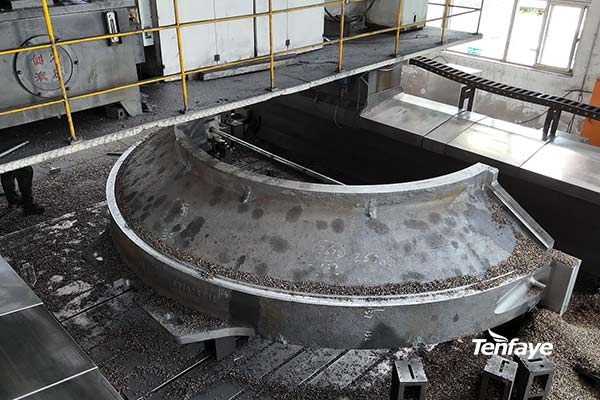
For OEMs and industrial buyers sourcing a custom steam turbine partition sleeve, the most useful starting point is a complete drawing package with the material specification, critical dimensions, machining requirements and applicable inspection criteria.
Send your drawings and technical specifications to Tenfaye for a factory quotation. The manufacturing scope and feasibility can then be reviewed against the actual requirements of your component.
If you have any other questions, please feel free to contact whatsapp: +8618037881433 ,
you can also leave us message, we will warmly serve for you!