
Published:16:40 23 Nov, 2026
Quick Summary
Selecting a suitable girth gear for ball mills and rotary kilns requires evaluating gear structure, cast steel material, dimensions, tooth hardness, machining accuracy, and inspection standards. This guide covers the key selection criteria and explains how to choose a reliable manufacturer for large industrial girth gears.
Girth gears are essential transmission components in ball mills and rotary kilns. They transfer driving torque from the pinion to the rotating equipment and must withstand continuous loads, torque variations, and demanding operating conditions.
When selecting a Ball Mill Girth Gear or Rotary Kiln Girth Gear, buyers need to consider more than gear dimensions. Structure, material, tooth hardness, machining accuracy, and inspection requirements all affect gear performance and service life. The following factors can help equipment manufacturers and plant operators make informed purchasing decisions.
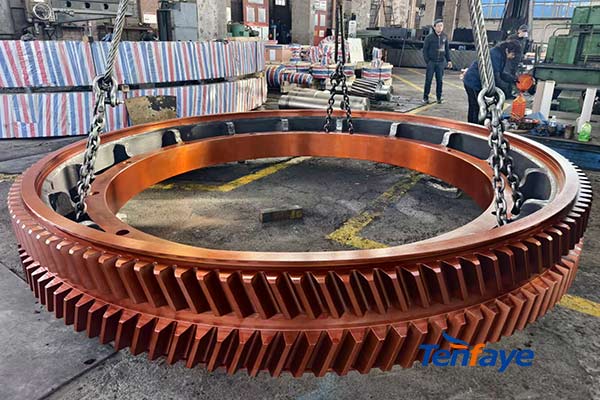
Girth gears are generally manufactured in two configurations:
The choice depends on gear diameter, transportation restrictions, installation conditions, and joint alignment requirements. For segmented gears, accurate joint machining and assembly are essential to maintain proper tooth engagement.
Cast steel girth gears are widely used in large industrial equipment because they can accommodate heavy loads and large component dimensions. Carbon steel and low-alloy cast steel are commonly selected according to the required mechanical properties.
When evaluating material specifications, buyers should check:
Ball mill and rotary kiln operating conditions are different, so material selection should follow the equipment design and actual load requirements rather than relying on a generic steel grade.
Dimensional compatibility is especially important for replacement girth gears. The new gear must match the existing equipment and engage correctly with the driving pinion.
| Parameter | What to Check |
|---|---|
| Gear diameter | Overall dimensions and installation space |
| Face width | Required load-bearing capacity |
| Module and number of teeth | Compatibility with the mating pinion |
| Pressure angle | Specified gear design |
| Tooth type | Spur, helical, or double-helical |
| Mounting dimensions | Flange, bolt holes, and connection structure |
Original 2D drawings or 3D models are preferred for manufacturing. If drawings are unavailable, equipment information, existing gear measurements, and clear photographs can help evaluate replacement feasibility.
For large components, the supplier's casting and machining capacity should also match the required dimensions and weight.
Girth gear teeth experience repeated contact stress during operation. Appropriate heat treatment helps achieve the required balance between surface wear resistance and core toughness.
Depending on the material and technical specifications, normalizing or quenching and tempering may be used to achieve the required mechanical properties.
For certain applications, tooth hardness may be specified at approximately 320–360 BHN. However, the actual hardness requirement should be confirmed against the approved drawings and material specifications.
Buyers should also consider hardness uniformity, section thickness, and the mechanical properties of the gear core rather than evaluating surface hardness alone.
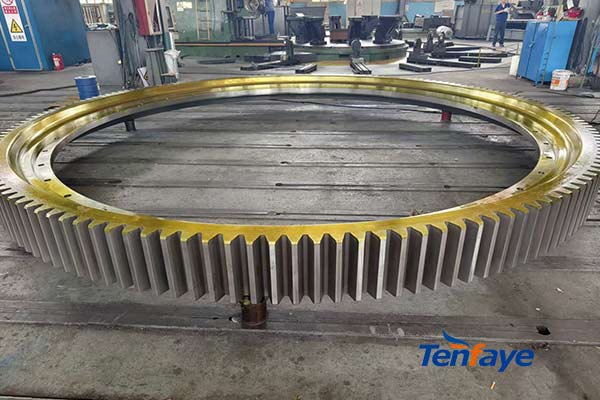
Machining accuracy directly affects tooth engagement, load distribution, and operating stability. Poor tooth geometry or excessive runout may cause uneven contact, vibration, and accelerated wear.
Important parameters include:
The required accuracy grade should be agreed upon according to DIN, AGMA, or ISO standards specified for the project. For replacement gears, the condition of the mating pinion and drive alignment should also be checked.
Inspection verifies the internal quality, material properties, and dimensional accuracy of large cast steel girth gears. Common inspection procedures include:
Inspection scope and acceptance criteria should be agreed upon before production. Material certificates and inspection reports, including EN 10204 3.1 documentation when specified, can support product quality verification.
| Selection Factor | Key Requirements | Supplier Confirmation |
|---|---|---|
| Structure | Integral or segmented | Manufacturing and installation feasibility |
| Material | Carbon or low-alloy cast steel | Material grade and mechanical properties |
| Dimensions | Diameter, width, module, teeth | Drawing and pinion compatibility |
| Hardness | Surface hardness and core toughness | Heat treatment requirements |
| Machining | Profile, pitch, and runout | Specified accuracy grade |
| Inspection | UT, MT, hardness, and dimensions | Testing standards and reports |
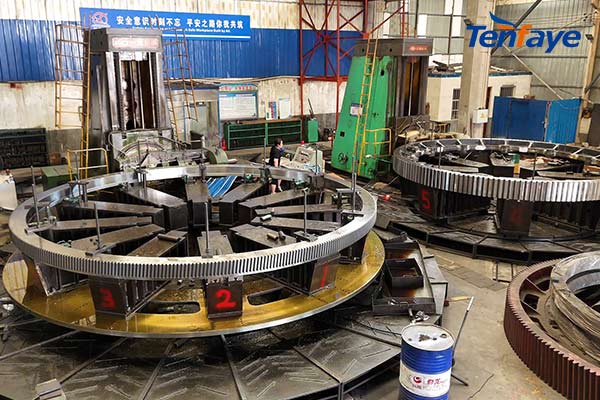
When comparing girth gear manufacturers, buyers should evaluate actual casting capacity, material control, heat treatment arrangements, machining resources, and inspection capabilities. Experience with large industrial gears is also important, particularly for replacement projects with specific dimensional requirements.
At Tenfaye, we manufacture custom large cast steel components weighing from 1 to 150 tons, including integral and segmented girth gears with diameters of up to 15 meters.
Our manufacturing services cover casting, heat treatment, machining, and quality inspection according to customer drawings and technical specifications. Material grades, dimensions, hardness, and inspection requirements can be confirmed during the technical review.
Whether you need a ball mill girth gear or a rotary kiln girth gear, providing complete drawings and technical requirements helps ensure an accurate manufacturing evaluation.
Both transmit torque to rotating equipment. Ball mill gears operate under grinding loads and torque variations, while rotary kiln gears must also accommodate thermal expansion and alignment changes.
Carbon steel and low-alloy cast steel are commonly used. The final grade depends on gear dimensions, mechanical properties, and operating conditions.
Provide technical drawings, diameter, face width, module, number of teeth, material grade, hardness, accuracy, and inspection requirements. Equipment type and quantity are also helpful.
Looking for a reliable cast steel girth gear manufacturer? Send us your drawings and technical specifications for a factory quotation.
If you have any other questions, please feel free to contact whatsapp: +8618037881433 ,
you can also leave us message, we will warmly serve for you!