

Heavy industrial sectors, including mining, cement, metallurgy, power generation, and heavy machinery, depend on large steel castings to withstand high loads, continuous operation, impact stress, and demanding working conditions. When sourcing components weighing from several tons to over 100 tons, choosing a qualified large steel casting manufacturer directly affects equipment reliability, installation accuracy, and long-term maintenance costs.
Unlike standard foundry products, large custom steel castings require careful control of solidification, thick-section cooling, heat treatment, machining allowances, and non-destructive testing (NDT). Buyers should therefore evaluate more than a foundry's production capacity. Engineering experience, material control, inspection procedures, and manufacturing consistency are equally important.
This guide outlines six key factors to consider when selecting a reliable manufacturer for large steel castings used in heavy industrial equipment.
1. Evaluate Casting Capacity and Production Scale
The first step is to determine whether the manufacturer can produce components within the required weight and dimensional range. Large castings require suitable melting, molding, pouring, heat treatment, and handling capabilities throughout the production process.
Single-Piece Casting Weight
Confirm the maximum single-piece casting weight the manufacturer can handle under its actual production conditions. A capable heavy steel casting manufacturer should be able to explain its melting arrangements, pouring procedures, molding capacity, and production controls for large components.
For projects involving castings weighing 1–150 tons, buyers should verify that the foundry has relevant experience with similar component sizes and material grades.
Large Casting Dimensions
Weight is only one consideration. Large components such as girth gears, rotary kiln tyres, mill end covers, and rolling mill housings also require sufficient molding space, handling capacity, and machining arrangements.
For example, large industrial girth gears may reach diameters of up to 15 meters. Buyers should confirm that the manufacturer can accommodate the required dimensions throughout casting and subsequent machining.
CAE Casting Simulation
Large castings with thick sections are particularly susceptible to shrinkage porosity, hot spots, and other solidification-related defects. Casting simulation software helps engineers evaluate molten steel flow, temperature distribution, feeding conditions, and solidification behavior before production.
Using CAE simulation during the engineering review can help optimize gating systems and riser placement, reducing potential casting defects and improving internal soundness.
2. Verify Material Control and Metallurgical Quality
Material selection directly influences the strength, toughness, wear resistance, and service life of large steel castings. The manufacturer should be familiar with the material grades and international standards specified in the customer's drawings.
Common Cast Steel Materials
Depending on operating conditions and mechanical requirements, large industrial castings may be manufactured from carbon steel, low-alloy steel, or stainless steel.
Common cast steel grades include:
- ZG230-450
- ZG270-500
- ZG310-570
- ZG35CrMo
- ZG42CrMo
- ZG35CrNiMo
- ZG40CrNiMo
Equivalent ASTM, DIN, EN, JIS, or GB material standards can also be considered according to project specifications.
Chemical Composition Verification
Reliable material control begins with the verification of chemical composition. Elements such as carbon, manganese, silicon, phosphorus, and sulfur must be controlled according to the specified material grade.
Optical emission spectrometers can be used to analyze molten steel before pouring and verify material composition. Buyers should also request material test reports to confirm that the supplied castings meet the agreed chemical and mechanical requirements.
3. Check Heat Treatment Capabilities
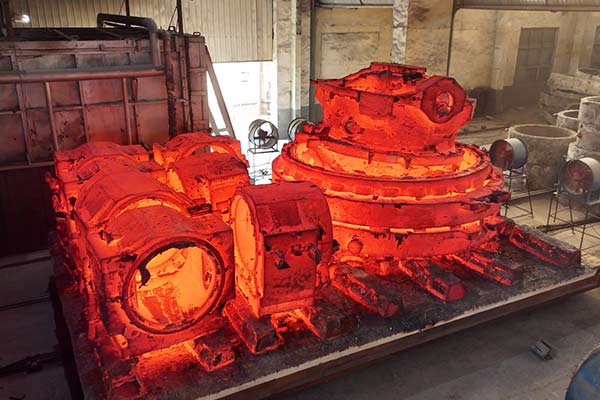
Heat treatment is a critical stage in the production of large steel castings. Thick sections cool at different rates, which can result in residual stresses, non-uniform microstructures, and dimensional instability if not properly controlled.
Suitable Heat Treatment Processes
Depending on the material grade, component geometry, and required mechanical properties, heat treatment processes may include:
- Annealing: Helps improve material uniformity and reduce internal stresses.
- Normalizing: Refines the microstructure and improves mechanical consistency.
- Quenching and Tempering: Provides the required balance of strength, toughness, and hardness where specified.
- Stress Relief: Helps reduce residual stresses in large cast components.
Temperature Control and Dimensional Stability
For oversized steel castings, heat treatment furnace capacity and temperature uniformity are important considerations. Controlled heating, holding, and cooling procedures help achieve the required material properties across thick sections.
Proper heat treatment planning also helps stabilize the casting before heavy machining, reducing the risk of dimensional changes during subsequent processing.
4. Assess Heavy Machining and Dimensional Accuracy
Large steel castings often require substantial machining before they can be installed in industrial equipment. Buyers should evaluate whether the manufacturer can coordinate the required machining operations according to the technical drawings.
Machining Requirements
Typical machining requirements for heavy industrial castings include:
- Large-diameter turning and facing
- Boring and milling of mounting surfaces
- Machining of bearing seats and fitting surfaces
- Drilling and tapping of connection holes
- Gear tooth machining and finishing where required
Machining Allowances and Drawing Review
Machining allowances, datum references, and critical dimensions should be reviewed during the casting engineering stage. This is especially important for components with complex geometries and multiple assembly interfaces.
Before placing an order, buyers should confirm the manufacturer's ability to coordinate the required machining and dimensional inspection. This helps ensure that the finished component meets drawing requirements and fits the intended equipment assembly.
5. Review Quality Inspection, NDT, and Traceability
For large steel castings used in mining, cement plants, steel mills, and power stations, documented quality inspection is essential. Inspection requirements should be agreed upon before production rather than introduced only after casting is completed.
A qualified manufacturer should have clear inspection procedures covering material composition, mechanical properties, internal soundness, surface integrity, and dimensional accuracy.
| Inspection Stage | Verification Methods | Purpose |
|---|---|---|
| Material Verification | Spectrometer analysis, tensile testing, impact testing | Verify chemical composition and mechanical properties. |
| Internal Soundness | Ultrasonic Testing (UT), Radiographic Testing (RT) where specified | Identify internal discontinuities and potential casting defects. |
| Surface Integrity | Magnetic Particle Testing (MT), Liquid Penetrant Testing (PT) where specified | Detect surface and near-surface cracks. |
| Dimensional Inspection | Dimensional measurement, runout checks, gear profile and pitch inspection | Verify critical dimensions and assembly interfaces. |
| Documentation | Material Test Reports, NDT reports, heat treatment records | Maintain quality records and production traceability. |
Material Traceability and Inspection Records
For projects requiring documented material verification, EN 10204 3.1 inspection certificates provide important information about material test results and compliance. Depending on the project requirements, buyers should also request relevant NDT reports, mechanical test results, dimensional inspection records, and heat treatment documentation.
Clear inspection procedures and traceable production records help buyers assess manufacturing quality before shipment.
6. Evaluate Engineering Experience and Product Applications
Manufacturing large steel castings requires more than adequate equipment. Experience with different industrial applications helps a foundry understand component geometry, load conditions, material requirements, machining interfaces, and potential manufacturing risks.
When evaluating a large steel casting manufacturer, buyers should consider its experience with components used in their specific industry.
Cement and Mining Equipment
- Cast steel girth gears for ball mills and rotary kilns
- Rotary kiln tyres and support components
- Ball mill end covers and trunnions
- Vertical mill grinding tables
- Crusher components and other heavy castings
Metallurgical Machinery
- Slag pots and slag ladles
- Rolling mill housings
- Rolling mill chocks
- Heavy-duty bearing housings
Power Generation and Hydropower
- Steam turbine partition sleeves and holding rings
- Large cast steel valve bodies
- Hydropower turbine cast components, subject to project requirements
Relevant manufacturing experience helps buyers assess whether a supplier understands the technical requirements of their equipment and can manufacture components according to project-specific drawings.
Tenfaye – Custom Large Steel Casting Manufacturer in China
Established in 2006 in Henan, China, Tenfaye specializes in manufacturing custom large carbon steel, low-alloy steel, and stainless steel castings for heavy industrial equipment. With a 100,000 m² manufacturing facility and more than 300 employees, Tenfaye produces steel castings weighing from 1 to 150 tons per piece.
Our manufacturing capabilities cover casting, heat treatment, heavy machining coordination, and quality inspection. Production is carried out according to customer drawings, material specifications, and technical requirements.
Manufacturing and Quality Control
- Melting: Two 25-ton electric furnaces for steel melting.
- Heat Treatment: Two natural-gas heat treatment furnaces.
- Engineering: German casting simulation software for casting process analysis.
- Material Testing: OBLF spectrometer for chemical composition verification.
- NDT Inspection: Ultrasonic Testing (UT) and Magnetic Particle Testing (MT).
- Documentation: Material verification and inspection documentation, including EN 10204 3.1 where required.
Custom Large Steel Casting Products
Tenfaye supplies custom steel castings for a range of heavy industrial applications:
- Cement and Mining: Girth gears, rotary kiln tyres, ball mill end covers, trunnions, support rollers, and vertical mill grinding tables.
- Metallurgical Machinery: Slag pots, slag ladles, rolling mill housings, rolling mill chocks, and bearing housings.
- Power Generation: Steam turbine partition sleeves, holding rings, and large cast steel valve bodies.
With experience serving international industrial customers, Tenfaye focuses on custom manufacturing based on technical drawings and project specifications. Each project can be reviewed for casting feasibility, material requirements, machining allowances, and inspection standards before production.
Whether you are sourcing new components for heavy machinery or replacement castings for existing equipment, selecting a manufacturer with suitable production capacity and quality control procedures is essential.
Frequently Asked Questions
1. What is the maximum weight of a large steel casting?
The maximum casting weight depends on the foundry's melting, molding, pouring, and handling capabilities. Tenfaye manufactures custom steel castings weighing from 1 to 150 tons per piece, subject to component design and technical requirements.
2. What materials are commonly used for large steel castings?
Common materials include carbon steel, low-alloy steel, and stainless steel. Grades such as ZG230-450, ZG270-500, ZG35CrMo, and ZG42CrMo are used according to the required mechanical properties and operating conditions.
3. What inspections are required for heavy steel castings?
Typical inspection requirements include chemical composition analysis, mechanical testing, ultrasonic testing (UT), magnetic particle testing (MT), and dimensional inspection. The exact inspection scope depends on the component, material specification, and customer requirements.
Request a Quotation for Your Large Steel Casting Project
Looking for a reliable large steel casting manufacturer in China? Send Tenfaye your 2D drawings, 3D models, material specifications, and inspection requirements for a technical review.
Our team will review your project requirements and provide feedback on manufacturing feasibility and quotation.
Send your drawings to info@tenfaye.com for a factory quotation.