
Published:14:38 17 Nov, 2026
At Tenfaye's foundry in Huixian, Henan, China, custom cast steel girth gear production begins in the pattern shop, long before the steel is melted. Wooden patterns are carefully prepared according to the required dimensions, shrinkage allowances and machining requirements. For large girth gears used in rotary kilns and ball mills, pattern accuracy is the first step toward achieving the required casting dimensions and machining precision.
The production process starts with pattern preparation and resin-bonded sand molding. Large gear molds are assembled in sections on the foundry floor, with the molding process planned according to the gear's dimensions, structural requirements and casting weight.
Depending on the application, transportation conditions and installation requirements, girth gears can be manufactured as integral castings or segmented sections. Both configurations require careful control of mold assembly, casting structure and machining allowances.
Steel melting and composition control are carried out according to the specified material grade and technical requirements. Before pouring, the molten steel is checked to ensure that its chemical composition meets the required specifications.
During pouring, temperature, filling conditions and riser arrangements are carefully controlled to support proper solidification and reduce the risk of shrinkage defects. Due to their large dimensions and heavy sections, large cast steel girth gears require extended cooling periods before shakeout.
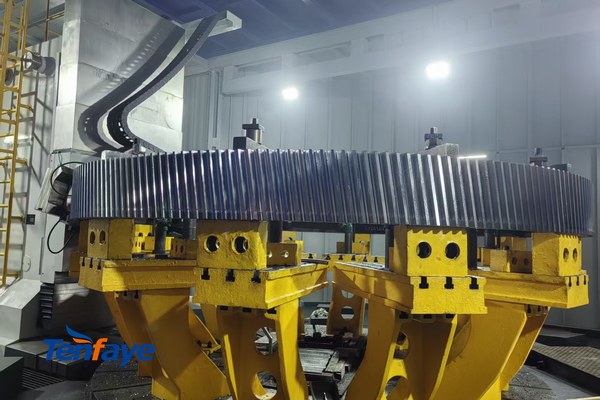
After shakeout, the gating system and risers are removed, and the casting undergoes shot blasting to clean its surface and prepare it for subsequent operations.
Heat treatment is then performed according to the material grade and technical specifications. Processes such as normalizing or annealing help refine the steel's microstructure, improve material properties and relieve residual stresses generated during casting.
Once heat treatment is completed, the casting moves to rough machining. Vertical turning machines are used to machine the end faces and central bore, establishing the reference surfaces for subsequent machining operations.
Dimensional accuracy and concentricity at this stage are important because they directly affect the positioning and accuracy of later gear cutting operations.
Tooth cutting is one of the most critical stages in girth gear manufacturing. Based on the customer's drawings and technical requirements, the gear's module, pressure angle, helix angle and tooth profile are set before machining.
Tenfaye manufactures different types of cast steel girth gears, including spur, helical and double-helical designs. Depending on the equipment application and transportation requirements, gears can be supplied as integral rings or segmented sections.
During machining, tooth geometry, pitch accuracy and profile dimensions are controlled according to the specified requirements. For segmented girth gears, joint faces are also machined, and corresponding sections are match-marked to facilitate correct alignment during installation.
For large ball mill and rotary kiln applications, proper machining of the bore, mounting surfaces and gear teeth is essential to ensure reliable installation and operation.
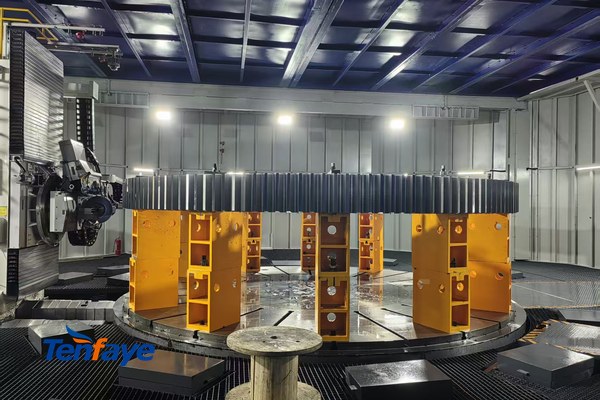
Quality inspection is carried out throughout the manufacturing process, from raw material control to final machining.
Before dispatch, critical casting areas can undergo ultrasonic testing (UT) and magnetic particle testing (MT), according to the customer's inspection requirements. Hardness testing is performed on specified areas, while mechanical properties are verified through test specimens prepared in accordance with the applicable standards.
Dimensional inspection covers key features such as bore dimensions, face runout and gear tooth geometry. Material test reports and EN 10204 3.1 inspection certificates can also be provided according to order requirements.
After final inspection, finished girth gears are painted, and machined surfaces and tooth areas are properly protected. Suitable packing is arranged according to the gear dimensions and international transportation requirements before shipment.
Tenfaye manufactures custom cast steel girth gears for heavy-duty industrial equipment, including rotary kilns, ball mills and other large rotating machinery.
With manufacturing capabilities for girth gears up to 16 meters in diameter, Tenfaye can supply integral and segmented gear solutions based on customer drawings and project requirements. Material selection, casting processes, heat treatment and machining arrangements are determined according to the specific operating conditions and technical specifications.
For replacement projects, existing drawings, original gear drawings or relevant technical information can be used as the basis for manufacturing evaluation. Wooden patterns from previous projects may also be retained for future repeat orders, helping simplify the preparation process when replacement gears are required.
Looking for a custom cast steel girth gear for your ball mill or rotary kiln?
Send us your drawings and technical specifications for a factory quotation.
If you have any other questions, please feel free to contact whatsapp: +8618037881433 ,
you can also leave us message, we will warmly serve for you!