
Published:11:31 11 Nov, 2026
Large girth gears are critical transmission components used in cement mills, rotary kilns, mining equipment and other heavy industrial machinery. Their accuracy affects tooth contact, load distribution and transmission stability. Understanding gear accuracy standards and industry requirements helps manufacturers and buyers define appropriate technical specifications for large cast steel girth gears.
Large industrial girth gears operate under demanding conditions, including heavy loads, continuous operation, dust and mechanical vibration. Accurate tooth geometry helps maintain proper engagement between the girth gear and its driving pinion.
When specifying a large girth gear, several factors should be considered:
Gear accuracy should therefore be specified together with material, machining, inspection and installation requirements.
DIN, ISO and AGMA are important references in industrial gear manufacturing. However, their classification systems and tolerance definitions are not directly interchangeable.
| Standard | Description | Important Notes |
|---|---|---|
| DIN 3962 | A historical German standard for tolerances of cylindrical gear teeth. | DIN 3962-1:1978-08 is withdrawn. DIN lists DIN ISO 1328-1 as its replacement. |
| ISO 1328-1:2013 | An international system for classifying cylindrical involute gear tooth flank tolerances. | Defines gear flank deviations and allowable tolerance values. Classes 1–11 are arranged in order of increasing tolerance. |
| AGMA 2000-A88 | A historical American gear classification and inspection standard using Q3–Q15 quality levels. | Withdrawn and replaced by several subsequent AGMA standards. Its Q grades should not be directly converted into modern grade numbers. |
ISO 1328-1:2013 covers individual cylindrical involute gears and defines tolerances related to tooth flank geometry. Important inspection characteristics include:
These parameters provide a more meaningful basis for evaluating gear accuracy than simply comparing grade numbers from different standards.
For large girth gears, the applicable standard, tolerance class, gear dimensions and inspection method should be confirmed in the technical specification before manufacturing.
Different industrial applications place different demands on girth gear performance. Operating speed, transmitted torque, load variations, environmental conditions and equipment design all influence the required accuracy and manufacturing process.
| Industry | Typical Equipment | Key Manufacturing and Quality Considerations |
|---|---|---|
| Cement & Building Materials | Rotary Kilns, Ball Mills, Raw Mills | Continuous operation, heavy torque, tooth wear resistance, material strength and lubrication. |
| Metallurgy | Converters, Sintering Machines, Rolling Mills | Load variations, mechanical impact, material toughness, casting quality and tooth contact. |
| Mining Machinery | Ball Mills, SAG Mills, Mining Hoists | High torque, large gear dimensions, segmented construction, joint machining and assembly alignment. |
| Sugar Industry | Cane Crushers, Crystallizers, Rotary Drums | Low-speed transmission, structural rigidity, material selection and environmental protection. |
| Fertilizer & Chemical | Rotary Dryers, Granulators, Reactors | Operating loads, corrosion exposure, structural stiffness, machining quality and maintenance requirements. |
Cement rotary kilns and ball mills use large girth gears to transmit torque under continuous operating conditions. Manufacturing should focus on suitable cast steel materials, heat treatment, tooth machining and inspection. Proper lubrication and installation alignment are also essential for reliable operation.
Metallurgical equipment may experience fluctuating loads and mechanical impact. Material toughness, casting quality, heat treatment and tooth contact conditions should be evaluated according to the actual equipment requirements.
Large mining mills often require heavy-duty girth gears with substantial diameters and high torque capacity. For segmented gears, joint-face machining, bolt-hole positioning and segment alignment are important factors in final assembly quality.
Girth gears used in sugar processing equipment commonly operate in open-drive transmission systems. Material selection, tooth machining, structural rigidity and environmental protection should be considered according to the working conditions.
Rotary dryers and granulators use girth gears under different load and environmental conditions. Material properties, corrosion protection, machining accuracy and maintenance requirements should be evaluated for each application.
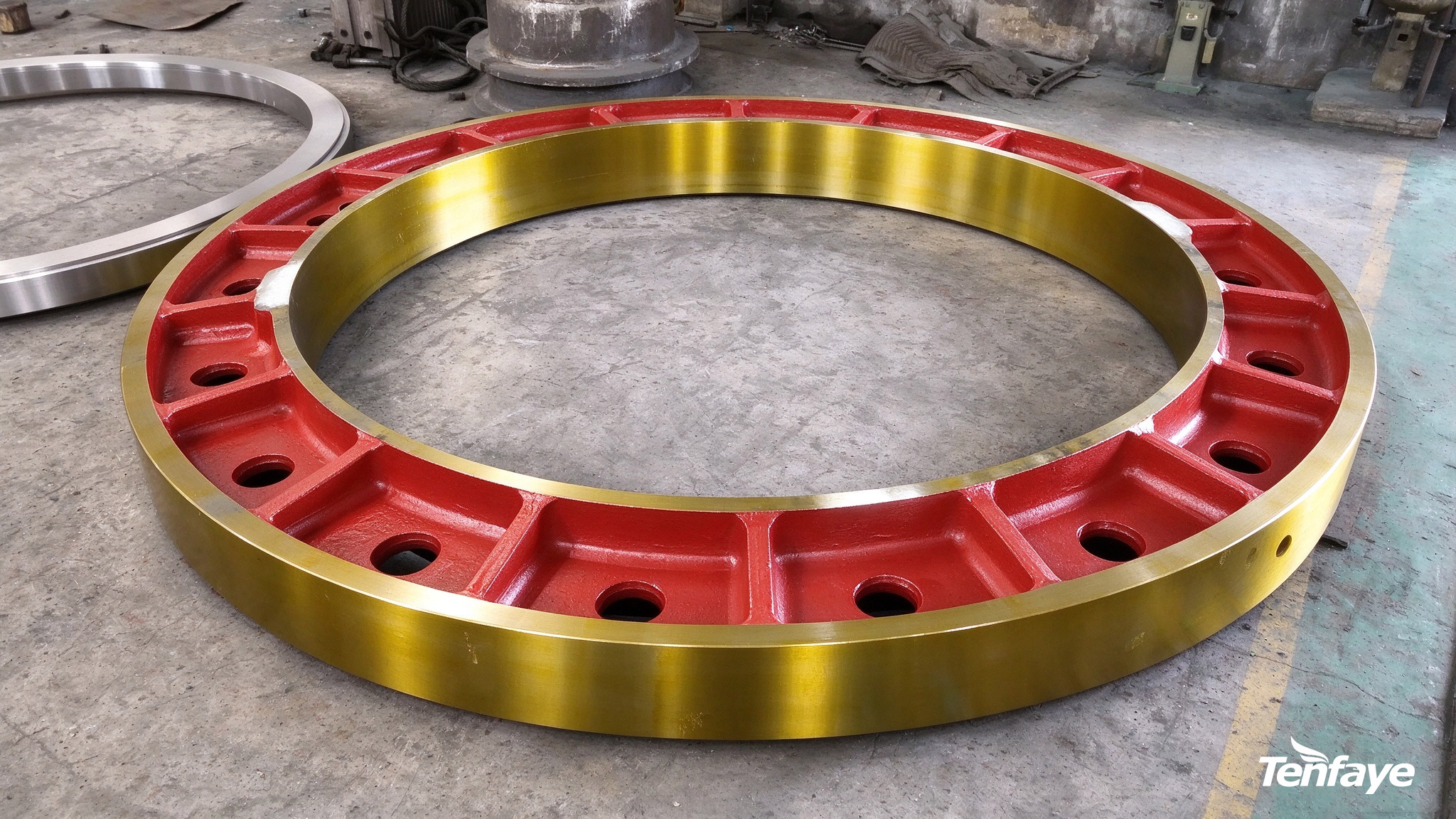
The final quality of a large cast steel girth gear depends on coordinated control of casting, heat treatment, machining and inspection.
Carbon steel and low-alloy cast steel may be selected according to gear dimensions, transmitted torque and required mechanical properties. Heat treatment processes such as normalizing, tempering and quenching and tempering should be determined by the material specification and engineering requirements.
Gear hobbing, milling and tooth profile grinding are selected according to gear dimensions, tooth geometry and required accuracy. Additional finishing operations may be necessary when tighter tolerances are specified.
Typical inspection activities for large cast steel gears may include:
Inspection methods, sampling scope and acceptance criteria should be agreed upon before production in accordance with the applicable standards and customer specifications.
Choosing an appropriate accuracy requirement involves more than selecting a grade number. Buyers and manufacturers should evaluate the following factors:
A higher accuracy grade does not automatically guarantee longer service life. Material quality, tooth geometry, lubrication, installation and operating conditions must work together to achieve reliable performance.
Tenfaye specializes in large custom cast steel components for cement, mining and other heavy industrial applications. We manufacture custom girth gears according to customer drawings, material specifications and project requirements.
Our manufacturing capabilities cover:
Each project can be evaluated according to its required dimensions, tooth geometry, material properties and inspection specifications.
Looking for a large girth gear manufacturer?
Send us your drawings or technical specifications for a factory quotation.
There is no single mandatory accuracy grade for all cement mill girth gears. The required grade depends on equipment design, operating speed, load conditions and the applicable gear accuracy standard.
DIN 3962 is a historical German gear tolerance standard. DIN 3962-1 has been withdrawn and replaced by DIN ISO 1328-1. ISO 1328-1 establishes an international classification system for cylindrical involute gear tooth flank tolerances.
Gear accuracy can be evaluated through measurements of pitch, tooth profile and helix deviations. Dimensional inspection, runout checks and other project-specific tests may also be required.
If you have any other questions, please feel free to contact whatsapp: +8618037881433 ,
you can also leave us message, we will warmly serve for you!