
Published:17:55 22 Oct, 2026
Rolling mill chocks support the bearings that carry work rolls and backup rolls in a rolling mill. Although they are often described as bearing housings, their role extends beyond holding a bearing. The chock must fit the bearing assembly, locate correctly within the mill stand and maintain the required alignment under operating loads.
For steel mills purchasing replacement roll chocks or commissioning new components, several details deserve attention before production begins. Bearing fit, casting structure, machining allowances and dimensional inspection can all affect whether a finished chock matches the original equipment.
Work roll chocks and backup roll chocks serve different positions in the rolling mill.
Work roll chocks accommodate the bearings supporting the work rolls, which contact the steel strip or other material being rolled. Backup roll chocks support the backup rolls in mill configurations that use them to support the work rolls against rolling forces.
The two types may differ in overall dimensions, bearing arrangements, mounting features and lubrication provisions. Their designs depend on the mill stand and roll assembly, so a work roll chock drawing should not be used as a substitute for a backup roll chock drawing.
When sourcing replacement rolling mill chocks, buyers should identify the roll position and equipment model, then confirm the component drawing and revision. These details help establish the correct manufacturing requirements before a new casting is produced.
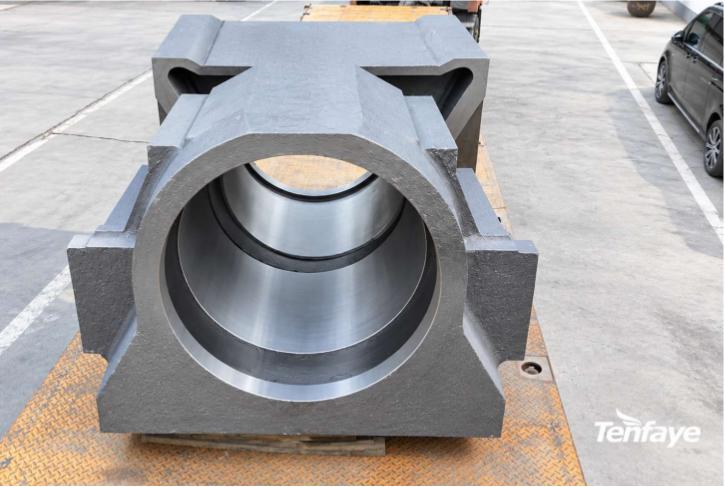
The bearing bore is one of the most important machined features of a rolling mill chock. Its dimensions and specified tolerances must correspond to the bearing arrangement and engineering design.
An incorrect bore size or geometry can affect bearing installation and the intended fit. Other interfaces, including locating surfaces and mounting features, must also match the mill structure. The required tolerances should therefore be taken from the approved drawing rather than assumed from the nominal bearing size alone.
For large cast steel roll chocks, machining allowances must be considered during casting design. The raw casting needs sufficient material in the areas that will be machined, while the casting process must also account for the component's shape and changes in section thickness.
A useful practice is to identify critical dimensions on the drawing before production. These typically include the bearing bore, mounting interfaces and other features that control assembly compatibility. Inspection can then focus on the dimensions that matter most to installation.
Material selection should begin with the specified steel grade and the component's mechanical property requirements. Carbon steel and low-alloy steel castings may be suitable for different chock designs, but the choice must follow the engineering specification.
The material designation alone does not establish that a casting is suitable. The required mechanical properties, heat treatment condition and acceptance criteria also need to be defined.
For large castings, section thickness and geometry influence solidification and cooling. These factors should be considered during casting process planning because they affect how the component is produced and subsequently processed.
Buyers should confirm the following information before ordering:
Required steel grade and material standard
Mechanical property requirements and applicable test conditions
Heat treatment requirements
Required non-destructive testing and acceptance criteria
Material documentation required for delivery
Where a replacement chock must match an existing specification, changing the material grade should not be treated as a simple purchasing decision. Any proposed change needs appropriate technical approval.
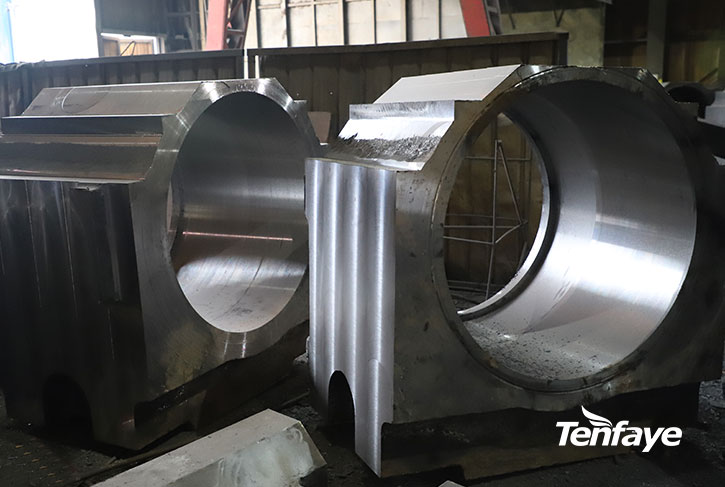
Large rolling mill chocks are not always simple, uniform blocks of steel. Their shapes can include heavy sections, openings and transitions between different wall thicknesses. These features require attention during mold design and casting process planning.
Casting simulation can help evaluate metal filling and solidification behavior. It supports process planning but does not replace the inspection requirements specified for the finished casting.
Machining allowance is another important consideration. The raw casting must provide sufficient material for the bearing bore and other finished surfaces to reach their specified dimensions. If the allowance is insufficient, the required geometry may not be achievable through machining.
For this reason, casting drawings and finished-part drawings should be reviewed together. The manufacturer needs to understand which surfaces remain as-cast and which require machining, as well as the dimensional requirements for each critical feature.
Replacing a rolling mill chock involves more than matching its external dimensions. A component that looks similar may still differ at the bearing bore, locating surfaces or mounting interfaces.
Before placing an order, buyers should check:
Drawing revision: Confirm that the supplied drawing corresponds to the current equipment configuration.
Bearing arrangement: Verify the specified bearing dimensions, fit requirements and relevant interfaces.
Material and heat treatment: Confirm the required grade, mechanical properties and treatment condition.
Machining scope: Identify which bores, mounting surfaces and locating features must be finished.
Inspection requirements: Specify dimensional checks, material tests and non-destructive testing where required.
Identification and documentation: Establish component markings and the inspection records required for acceptance.
If the original drawing is unavailable, existing parts and available technical documentation may help establish the required dimensions. However, critical interfaces should be verified rather than estimated from appearance alone.
Tenfaye manufactures large steel castings according to customer drawings and technical specifications. Its casting capability covers individual components from 1 to 150 tonnes, subject to the requirements of each project.
For custom rolling mill chocks, the manufacturing review should establish the component dimensions, material grade, casting requirements, machining scope and inspection criteria. These details form the basis for evaluating production feasibility and preparing a quotation.
For replacement roll chocks, providing the original drawing and identifying critical machined surfaces can help clarify the required finished condition. For new equipment projects, the approved engineering specification should define the material, tolerances and inspection requirements.
If your project involves large cast steel rolling mill chocks, work roll chocks or backup roll chocks, send Tenfaye the available drawings and technical specifications for review.
Send us your drawings for a factory quotation.
If you have any other questions, please feel free to contact whatsapp: +8618037881433 ,
you can also leave us message, we will warmly serve for you!